
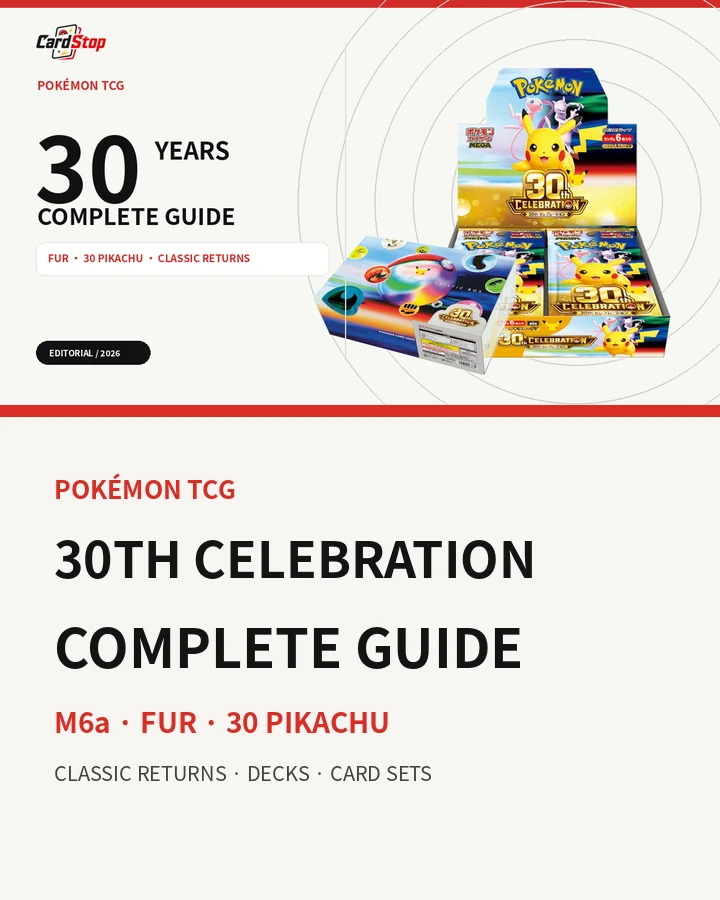
Pokémon’s thirtieth anniversary is much bigger than a gold logo on a booster pack. The September release of the M6a expansion 30th Celebration sits at the centre of a wider product line: a two-player Espeon and Umbreon Premium Deck Set, a YOSHIROTTEN-designed Futuristic Box, and nine generation-based Card Sets arriving in October. Together, they cover four very different pleasures—opening packs, playing the game, collecting art and revisiting the past.
For Hong Kong collectors, the Traditional Chinese M6a pack is the most accessible starting point. Its suggested retail price is HK$25. Every pack contains six foil cards, including one specially designed Basic Energy and one card from the 30-artist Pikachu project. The remaining four slots are random and can draw from regular cards, Pokémon ex, AR, SAR, the new FUR rarity and selected historic reprints.
That structure gives even a modest opening a clear anniversary moment. A pack does not need to contain the highest rarity to deliver a distinct illustration and a matching piece of the YOSHIROTTEN energy set. It also makes the product easy to understand for families or returning fans who have not followed every modern rarity code.
The anniversary looks backwards and forwards at the same time. Charizard, Lugia, Dark Tyranitar, Pikachu & Zekrom-GX and Magikarp return in special treatments that echo different periods of the game. On the other side of the card list, graphic artist YOSHIROTTEN uses spectral colour, circular symbols and metallic-looking surfaces to place Mew ex, Mewtwo ex and two Pikachu ex promos in a deliberately futuristic world.
This guide brings all of those threads together: the dates that matter, what each product actually contains, how an M6a pack works, the 30 Pikachu illustration project, the first official classic reprints, the full Espeon and Umbreon cards, and all 27 starter promos from the nine Card Sets.
| At a glance | Official detail |
|---|---|
| Traditional Chinese M6a release | 16 September 2026 |
| Hong Kong suggested retail price | HK$25 per pack |
| Pack contents | Six foil cards, including one Basic Energy and one 30th-anniversary Pikachu |
| Japanese suggested retail price | ¥360 per pack, tax included |
| New rarity | FUR, or Futuristic Rare |
| Illustration project | 30 artists and 30 Pikachu foil cards |
| Classic reprints | 30 in the full project; five card fronts shown on the official site so far |
| Premium Deck Set | 16 September 2026, ¥6,200 |
| Futuristic Box | 16 September 2026, ¥27,500 |
| Nine Card Sets | 16 October 2026, ¥1,200 each |
In this guide
- 01Three dates that define the 30th anniversary
- 02Four official products, four distinct experiences
- 03Inside M6a: six foil cards, two guaranteed slots
- 04FUR: YOSHIROTTEN draws the anniversary forward
- 05Thirty artists, thirty Pikachu—an art show in every pack
- 06Classic reprints: five official returns revealed so far
- 07Eight Legendary Pokémon—and a set that still wants to be played
- 08Espeon and Umbreon Premium Deck: see the full cards, not only the box
- 09Nine generations and 27 starter promos at a glance
- 10A practical buying guide for Hong Kong readers
01
Three dates that define the 30th anniversary
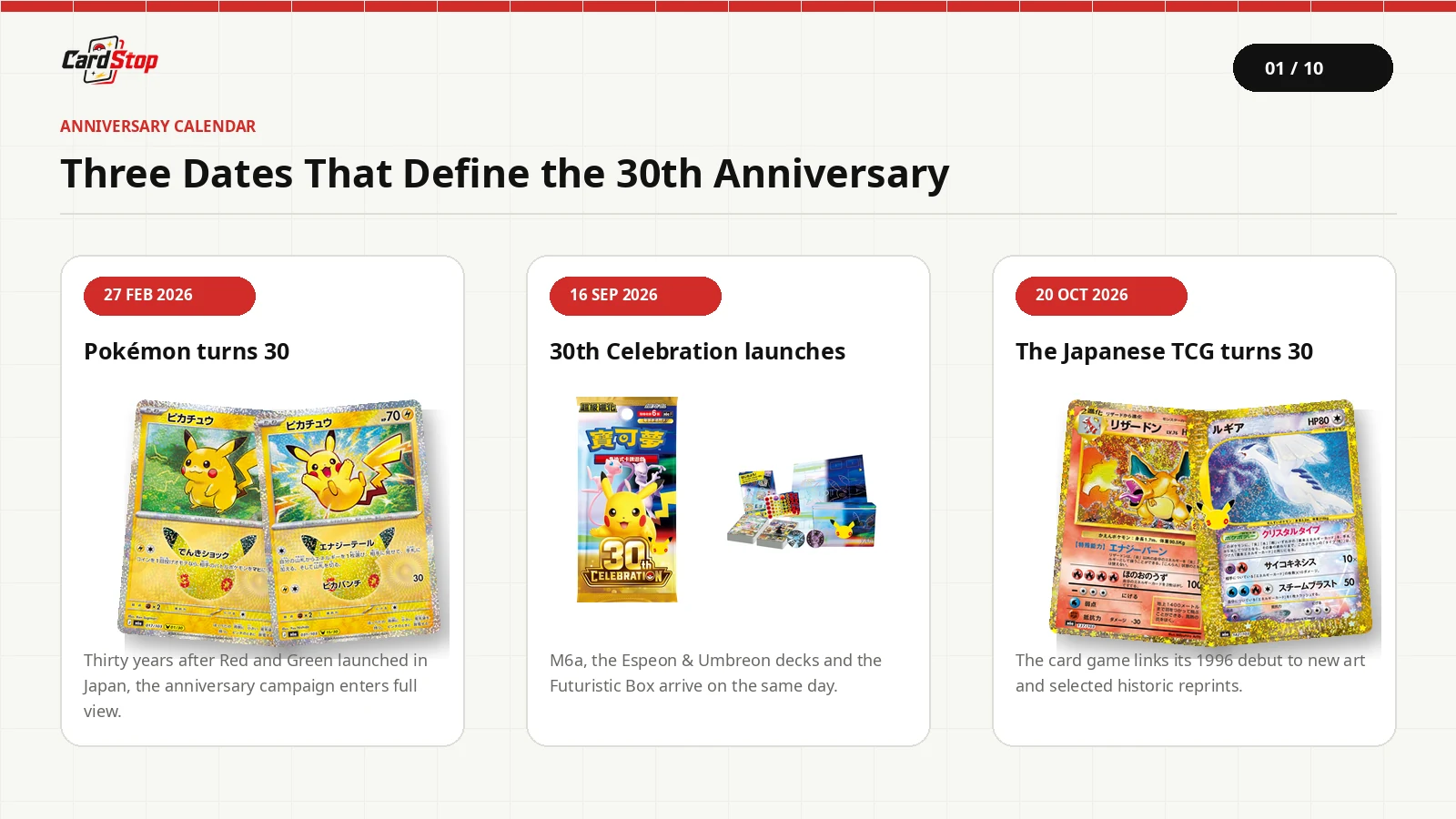
27 February: the Pokémon brand turns 30
Pokémon Red and Green launched in Japan on 27 February 1996, the date now celebrated as Pokémon Day. Thirty years later, the wider franchise anniversary began to unfold across games, animation, merchandise and the trading card game. It is the birthday of the Pokémon brand—not the release date of every anniversary card product.
That distinction matters in a very ordinary way. Seeing a 30th-anniversary trailer, campaign logo or collaboration in February does not mean M6a is already on sale. Collectors who want the booster pack, the Eeveelution decks or the Futuristic Box still need to look at the September product dates rather than social posts that simply say “the anniversary has begun.”
16 September: three major Japanese products arrive together
The key shopping date is 16 September. The Japanese M6a 30th Celebration expansion, the Espeon and Umbreon Premium Deck Set and the Futuristic Box all launch that day. The official Hong Kong page also lists the Traditional Chinese expansion for a simultaneous worldwide release.
Sharing a launch date does not make the products interchangeable. M6a is a random booster. The Premium Deck Set contains two fixed 60-card decks. The Futuristic Box focuses on two Pikachu ex FUR promos and a full range of accessories. Before comparing prices, it is worth asking whether the box contains packs, ready-made decks or display pieces.
20 October: the Japanese Pokémon Card Game turns 30
The Japanese trading card game debuted on 20 October 1996, almost eight months after Pokémon Red and Green. The card game therefore has its own thirtieth birthday. By releasing M6a in September, the official campaign builds momentum ahead of that date and carries it into October.
The nine starter Card Sets arrive on 16 October, four days before the TCG anniversary. Their 27 promos turn the final part of the campaign into a generational parade from Kanto to Paldea. The easiest way to remember the calendar is simple: February is the brand anniversary, September is the main product launch, and October is the trading card game’s own birthday.
02
Four official products, four distinct experiences
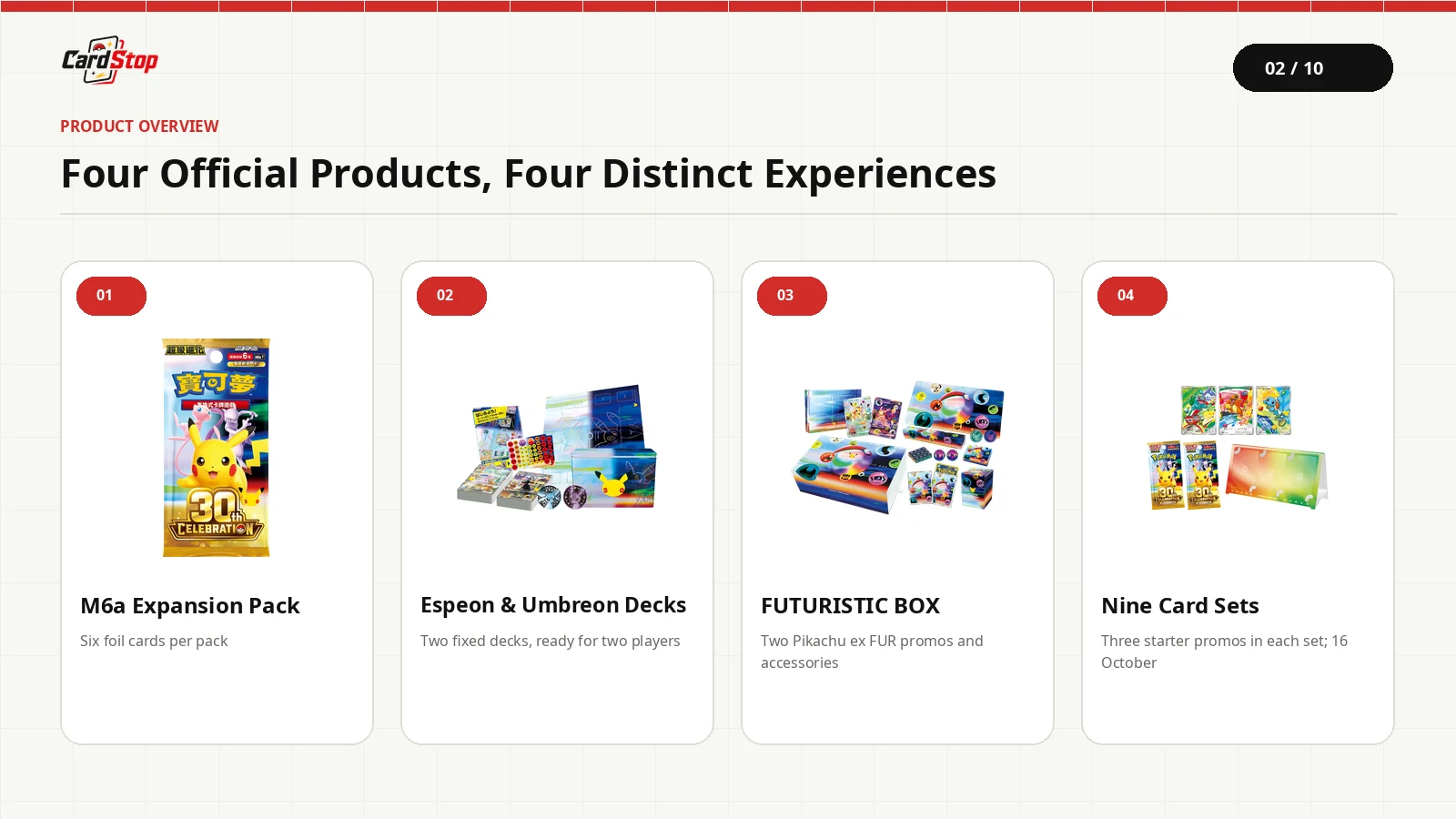
The anniversary range can appear complicated at first. One question makes it much easier: do you want to open packs, start playing immediately, collect the YOSHIROTTEN design language, or display a favourite generation of starter Pokémon?
| Product | What is inside | Best for |
|---|---|---|
| M6a 30th Celebration | Six random foil cards per pack | Pack opening, art cards and building the main set |
| Espeon & Umbreon Premium Deck Set | Two fixed 60-card decks, lead full-art cards and play accessories | Two people who want to start a game straight away |
| 30th Celebration Futuristic Box | Two Pikachu ex FUR promos and a full accessory suite | YOSHIROTTEN fans, display collectors and premium accessories |
| 30th Celebration Card Set | Three starter promos, two M6a packs and a three-card stand | Collectors who follow a generation or a starter trio |
M6a is the core card list
M6a is where the widest part of the anniversary story lives. It contains the 30-artist Pikachu project, FUR, AR, SAR, Legendary Pokémon, playable new cards and classic reprints. The main numbering runs to 103, followed by illustration cards, high-rarity treatments, reprints and special Energy cards beyond the base number. In other words, “103 cards” does not describe every anniversary variant a completist might pursue.
That flexibility is useful. A casual collector can finish a small favourite-character page. An art collector can follow Pikachu illustrators or YOSHIROTTEN. A set builder can aim at the main 103 before deciding whether the extra-number cards are worth the additional time and cost.
The Premium Deck Set is a complete game product
The Espeon and Umbreon product is not a bundle of random packs. It includes two fixed 60-card decks, one centred on Espeon ex and the other on Umbreon ex. Its headline cards are the full-art Espeon ex 043/040 and Umbreon ex 044/040. A metal double-deck case, playmat, Pokémon coins, counters and other play pieces complete the box.
For a new player, the advantage is certainty. There is no need to understand deck construction before the first game, and two people can learn from the same box. For an Eeveelution collector, the full card fronts and coordinated day-and-night accessories are the main draw.
The Futuristic Box is about design and accessories
The higher price of the Futuristic Box does not buy a large stack of boosters. The official contents list two Pikachu ex FUR promos, a 64-card sleeve set, half-size rubber playmat, playmat case, flip deck case, metal damage dice, metal Poison and Burn markers, two coins, a counter case and a display frame. Booster packs are not listed.
It should therefore be viewed as a premium anniversary design object, not a bulk-opening box. Collectors who only want the two promos may eventually compare the complete product with the single-card market, while buyers who genuinely want the playmat, cases and metal accessories receive the full visual system.
The Card Sets turn starter trios into displays
There are nine Card Sets, one for each generation. Every set contains three full-art promos featuring that generation’s starter Pokémon, two M6a packs and a paper three-card display stand. The correct official product image shows the three cards and the stand together. It is not a Starter Deck and it is not another large booster collection.
03
Inside M6a: six foil cards, two guaranteed slots
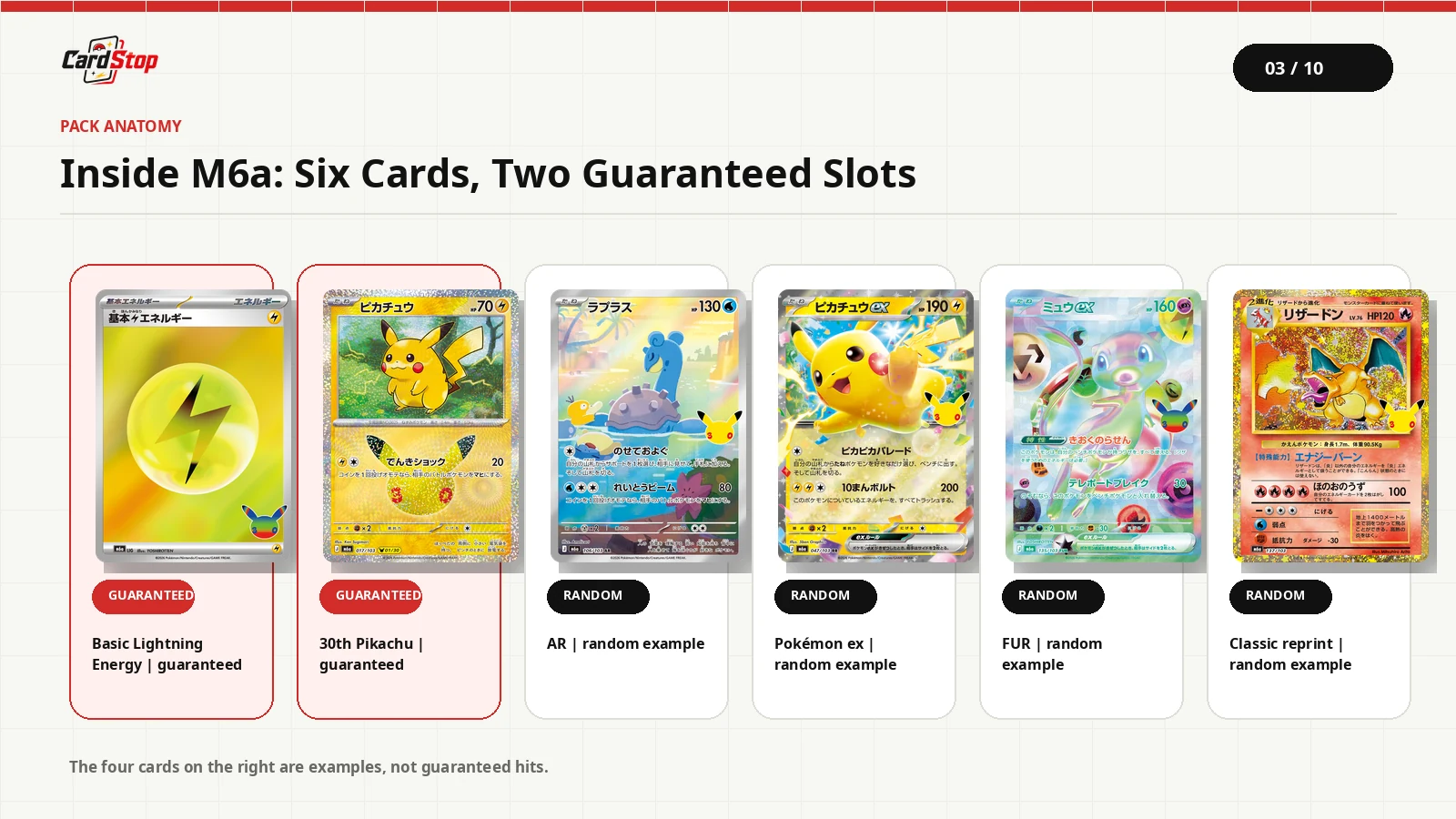
“Six foil cards in every pack” is an attractive headline, but foil treatment is not the same as rarity. It does not mean all six cards sit at the same collecting level, and it does not guarantee a FUR, SAR or classic reprint in every opening.
Guaranteed card one: a specially designed Basic Energy
Every pack contains one Basic Energy. Grass, Fire, Water, Lightning, Psychic, Fighting, Darkness and Metal all receive an anniversary look. YOSHIROTTEN carries the same spectral gradient and circular symbols across the eight cards, turning an everyday game component into a coherent mini-set.
For a casual buyer, the Energy is not simply filler. Eight types can make a compact display that is easier to complete than a full high-rarity set. Players can also bring a piece of the anniversary design into an ordinary deck without needing to use a rare attacker.
Guaranteed card two: one Pikachu from the 30-artist project
Each pack also contains one of the 30 anniversary Pikachu foil cards. Every illustration comes from a different artist, so the composition, atmosphere and drawing language can change dramatically from one card to the next. The guaranteed slot gives every opening a clear art-card moment, although the individual design remains random.
Duplicates will be a normal part of chasing all 30. Trading and buying missing singles will usually be more practical than trying to finish the project through packs alone. A numbered checklist also makes it much easier to separate duplicates from the personal collection.
The other four cards provide the random surprise
The remaining four positions draw from the broader M6a card pool. Official previews show regular cards, Pokémon ex, AR, SAR, FUR, Legendary Pokémon and classic reprints. The Lapras AR, Pikachu ex, Mew ex FUR and Charizard reprint shown in the visual are examples of possible card types—not a promise that one pack contains four major hits.
It helps to choose a goal before opening. A few packs are enough for the anniversary experience. Someone chasing the 30 Pikachu cards can open first, then trade duplicates. Someone who only wants Mew ex FUR, Mewtwo ex FUR or a single classic reprint may find singles more predictable than an unlimited pack chase.
A day in the life gives the set a visual story
M6a also connects a group of cards through changing light across the day. The two Pikachu ex SAR cards present brighter and darker scenes, while Lycanroc, Hisuian Zorua, Umbreon and Scraggy appear at different hours. They do not need to share one character or one rarity to feel like a sequence from morning to night.
This is an easy collecting route for readers who care more about images than tournament power. Place small previews side by side, look for a natural change in colour temperature, and choose either the two Pikachu ex cards, the wider day-and-night group, or one favourite scene. A small visual story can be more satisfying—and more manageable—than a full master set.
Loose packs, sealed product or singles?
Loose packs are a low-cost way to sample the release, but provenance and seal condition still matter. Sealed product suits buyers who value the opening experience, yet unofficial pull-rate claims should never be treated as a guarantee. Singles are the direct route when the wish list contains only one or two cards.
Hong Kong launch-week prices can move quickly. Checking the language, card number, physical condition, clear photographs and completed sales gives a much stronger reference point than one ambitious social-media asking price.
04
FUR: YOSHIROTTEN draws the anniversary forward
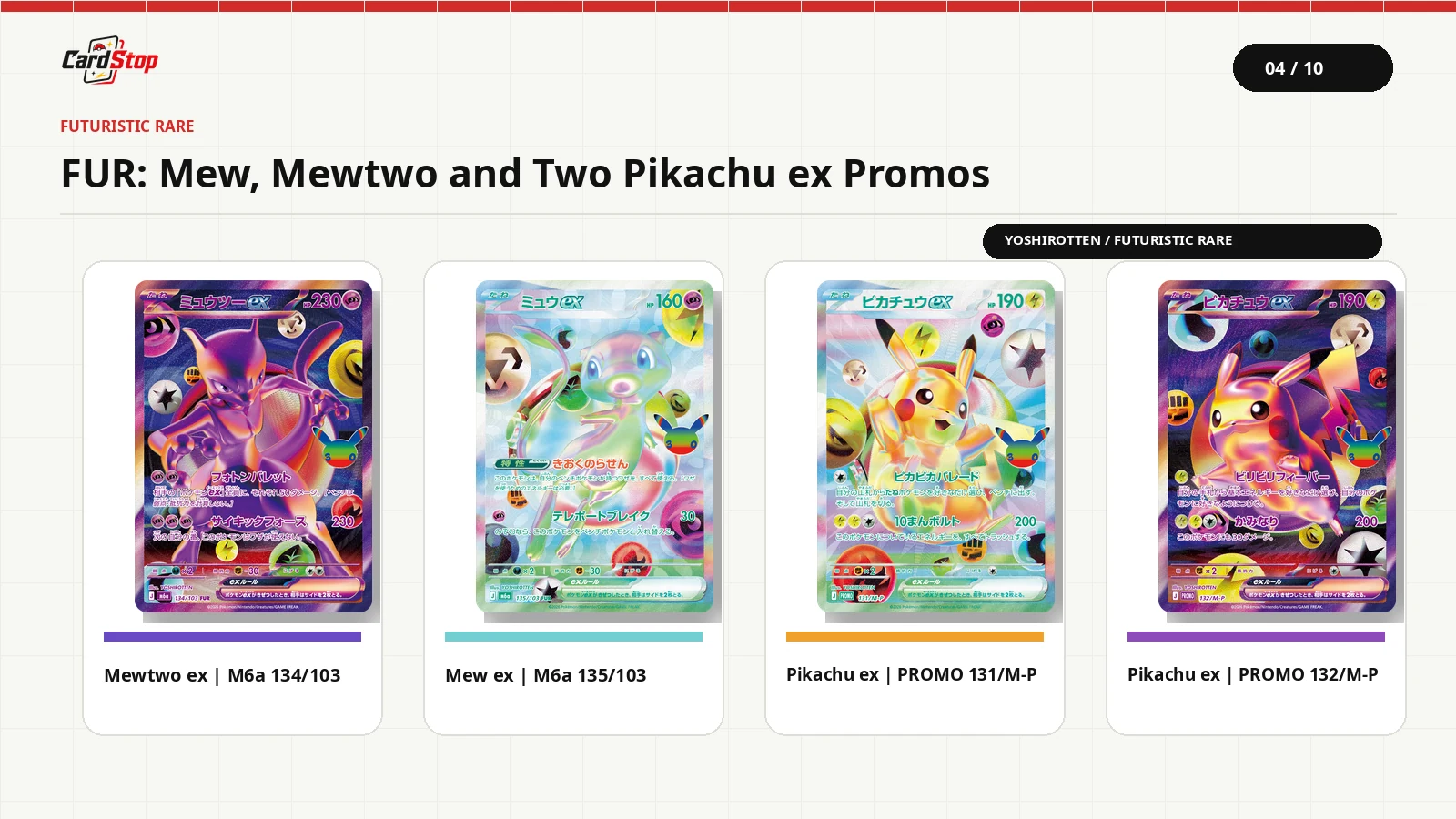
FUR stands for Futuristic Rare, a new rarity introduced with 30th Celebration. Its identity does not rely on the familiar formula of a gold border, heavy texture and realistic background. Instead, bright spectral colour, translucent layers, circular energy symbols and interface-like space create a cleaner, more synthetic look.
Mew ex and Mewtwo ex inside M6a
Mew ex 135/103 FUR uses silver-white, pale blue and soft colour transitions. Mew floats between energy symbols and feels light, fluid and optimistic. Mewtwo ex 134/103 FUR shifts to deep purple, red and black. Its composition is tighter and more forceful. Together, the two cards form an effective pair: gentle and sharp, open and concentrated.
YOSHIROTTEN does more than place each Pokémon on a rainbow background. The same visual vocabulary extends to the eight Basic Energy cards, the two Pikachu ex promos and the Futuristic Box sleeves, playmat, cases and metal pieces. FUR therefore feels less like an isolated rarity stamp and more like an anniversary art direction.
Two Pikachu ex promos in the Futuristic Box
Promo 131/M-P uses a lighter white, yellow and orange palette. Promo 132/M-P shifts toward purple, black and a night-like atmosphere. Both share the FUR design language, but neither sits in the random M6a card pool. They are fixed contents of the Futuristic Box.
That product distinction is essential. Opening M6a packs is not a route to these two cards. Buyers should also check the M-P promo numbers when comparing listings, rather than relying on a broad title such as “30th Pikachu FUR.”
Highly reflective surfaces make fine scratches and fingerprints more visible. A clean soft sleeve immediately after opening, followed by a rigid or semi-rigid holder for important cards, does more for long-term viewing than constantly handling the surface to inspect its shine.
05
Thirty artists, thirty Pikachu—an art show in every pack
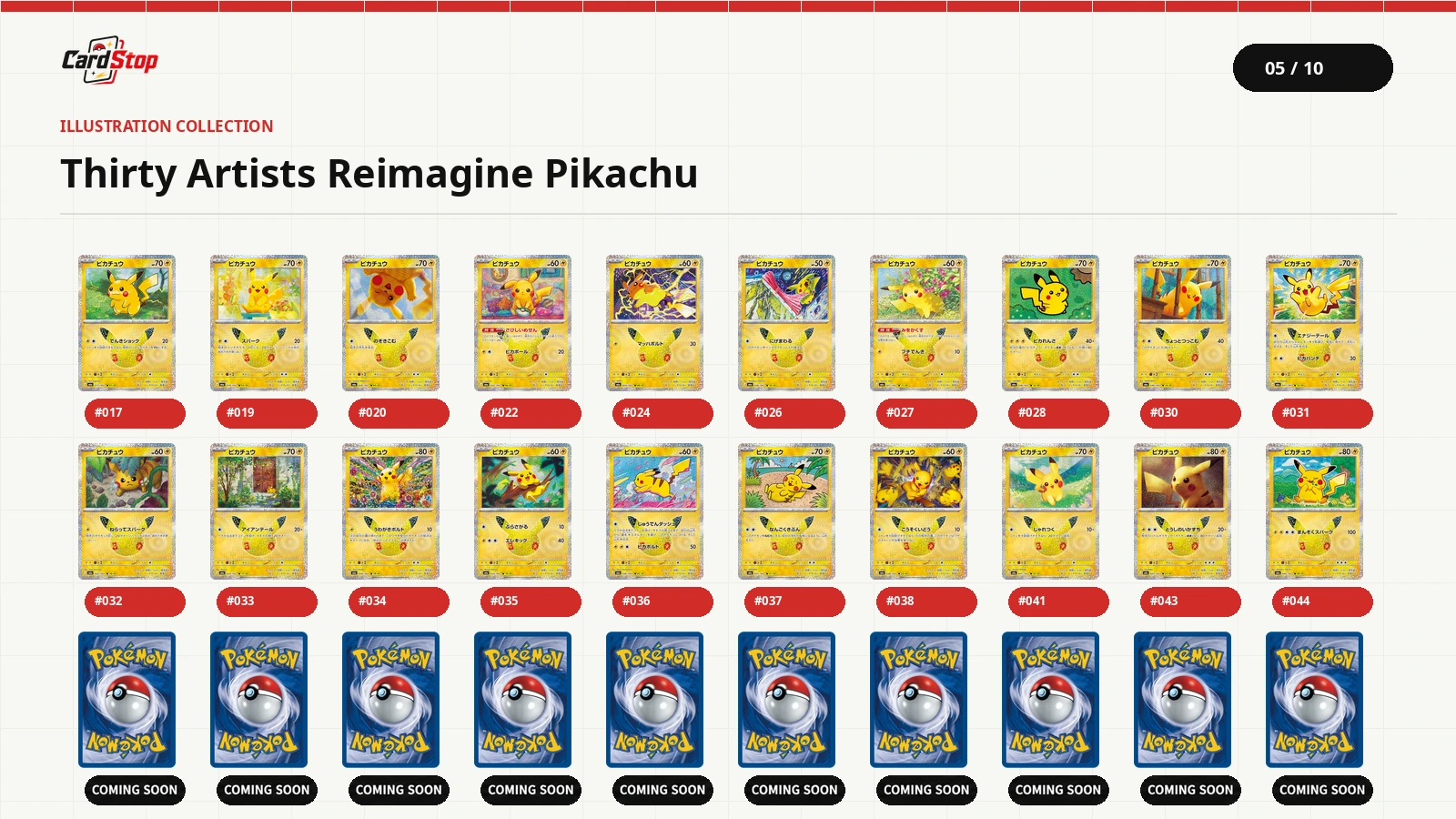
Pikachu may be the most recognisable Pokémon, but thirty artists can make the same character feel like thirty different worlds. Some cards resemble children’s picture books. Others use bold graphic shapes, domestic scenes, urban settings, natural landscapes or lively comic movement. The attraction is not simply “a yellow character with another background.”
The official set promises thirty Pikachu foil cards by thirty illustrators and guarantees one in every pack. As of 31 August 2026, the official card list displays twenty fronts. The visual in this report lays out all thirty positions: the twenty published cards appear as official fronts, while ten card backs reserve space for later official updates. It shows the scale of the project without filling the gaps with leaks or speculative images.
Start with the image, then learn the artist
A newcomer can sort the cards in a few intuitive ways: close portraits, everyday scenes, outdoor landscapes, comic action, graphic design and nostalgic line work. There is no correct taxonomy. The point is to notice which images make you stop scrolling and look again.
The project includes creators with very different relationships to Pokémon history. Ken Sugimori’s work can immediately recall early character art and the first card era. Atsuko Nishida is closely connected to Pikachu’s original character design. OKACHEKE, Yuu Nishida and kantaro bring contemporary colour, movement and story-led compositions.
Readers do not need to memorise a thirty-name roster before enjoying the cards. Choose three to five favourite illustrations first, then look at the artist credit printed along the lower edge. Starting from an image makes the name easier to remember, and it becomes more rewarding when the same artist appears in another set.
Duplicates can become trades or themed displays
One Pikachu in every pack means duplicates will rise with the number of packs opened. A simple numbered list and a separate duplicate box prevent unnecessary rechecking. Duplicates can then become trade material rather than disappointment.
They also create display options. A collector might arrange nine cards by colour, group several illustrations of quiet everyday life, or build a morning-to-night sequence. The project works for a casual buyer who owns only a handful and for a specialist who follows every artist and number. That range gives it more lasting interest than a set built around one expensive chase card.
06
Classic reprints: five official returns revealed so far
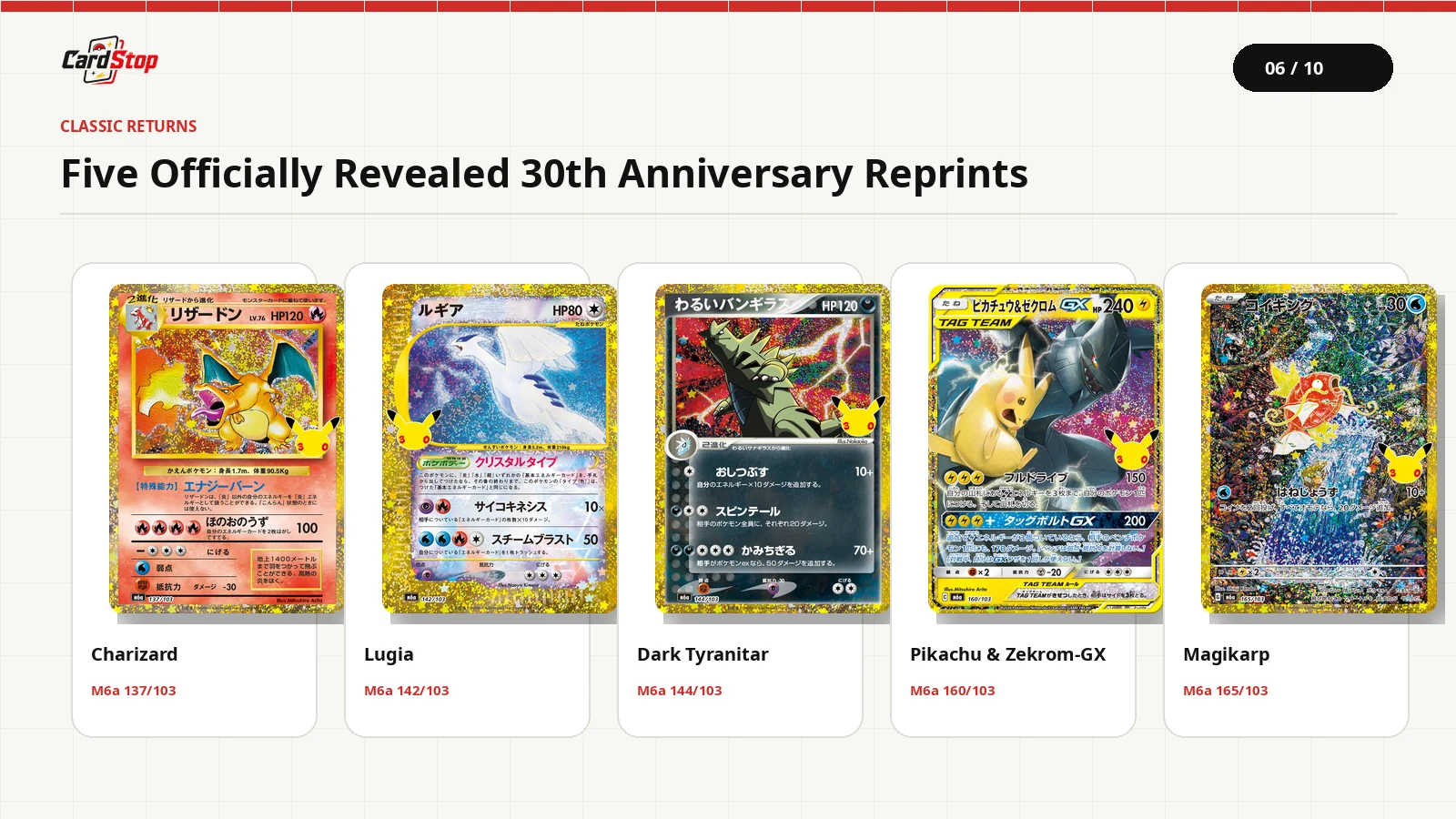
Thirty cards representing the history of the Pokémon TCG will return in special anniversary treatments. The official card list will continue to expand; for now, it displays five complete fronts: Charizard, Lugia, Dark Tyranitar, Pikachu & Zekrom-GX and Magikarp. Even this first group spans the early years, the e-Card era, Team Rocket storytelling, TAG TEAM-GX and illustration-led collecting.
Charizard 137/103: the defining first-generation image
Charizard revives the classic base-set composition with gold foil and a 30th-anniversary Pikachu emblem. For many returning collectors, the pose is inseparable from the first generation of Pokémon cards. The new printing lets a modern audience hold that image in a current product, but it is not a 1996 original and should never be represented as one.
Lugia 142/103: the transparency of the Crystal era
Lugia revisits a Crystal-type design, retaining the older frame and distinctive layout. Placed beside Charizard, it demonstrates how much card typography, text density and foil language changed across eras. It is a direct historical entry point for readers who know modern full-art cards but have rarely seen the e-Card period.
Dark Tyranitar 144/103: a whole theme in one card
The Dark Pokémon releases built an instantly recognisable mood around Team Rocket and altered character states. Dark Tyranitar returns not only because Tyranitar is popular, but because the card recalls an era when a set name, art direction and story atmosphere could shape a whole binder page.
Pikachu & Zekrom-GX 160/103: the TAG TEAM spectacle
TAG TEAM-GX placed two Pokémon on one card and emphasised partnership, powerful attacks and cinematic composition. Pikachu & Zekrom-GX remains one of the era’s defining pairings. Beside the single-character Charizard, it shows the long journey from a contained portrait frame to a widescreen-style duo.
Magikarp 165/103: memorable art is not limited to powerful characters
Magikarp proves that a card does not need a dominant battle role to become visually unforgettable. Repeated fish, dense splashing water and constant movement give the composition an identity of its own. Its return brings back the pleasure of collecting a picture because it is surprising, not because the character sits at the top of a power ranking.
The official page also notes that these special returns are not legal in the current Standard format. They can only be used where the rules permit the original card. Collecting and tournament legality are separate questions. To distinguish an anniversary reprint from its historic source, check the 30th Pikachu mark, the new card number, copyright line and foil treatment—not only the central illustration.
07
Eight Legendary Pokémon—and a set that still wants to be played
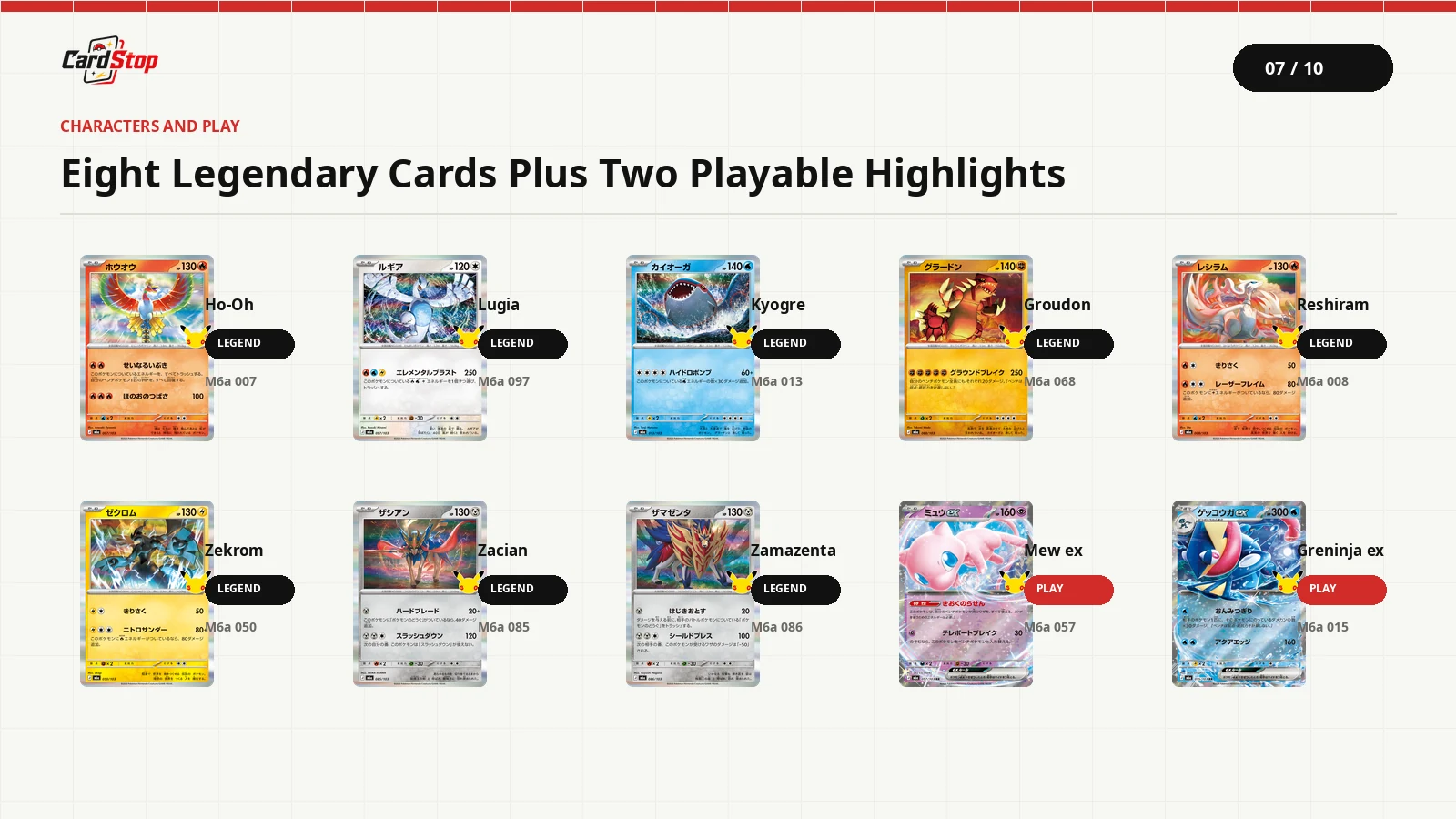
Anniversary releases are often treated as display-only products, but M6a retains the rhythm of an active trading card game. The official previews bring together Ho-Oh, Lugia, Reshiram, Zekrom, Kyogre, Groudon, Zacian and Zamazenta. Lined up, the eight cards resemble a compact poster of several game generations.
Familiar pairs give the card list a story
Ho-Oh and Lugia, Kyogre and Groudon, Reshiram and Zekrom, and Zacian and Zamazenta already carry clear generational relationships. A reader does not need to know every competitive deck to recognise the pairs. That structure feels more deliberate than a random selection of popular Legendary Pokémon and makes two-card displays easy to build.
Mew ex and Greninja ex are gameplay highlights
Mew ex can access attacks from Pokémon on the player’s Bench through its Memory Spiral Ability, creating more options as the deck provides more useful attacks. Greninja ex turns damage counters already on an opposing Pokémon into additional pressure, including threats beyond the Active position. Both cards reward timing and choice rather than relying only on a large printed number.
Collectors can follow character, generation and illustration. Players will also look at Energy costs, Evolution lines and the current rules environment. An anniversary mark creates attention; actual synergy is what keeps a card in a working deck.
08
Espeon and Umbreon Premium Deck: see the full cards, not only the box
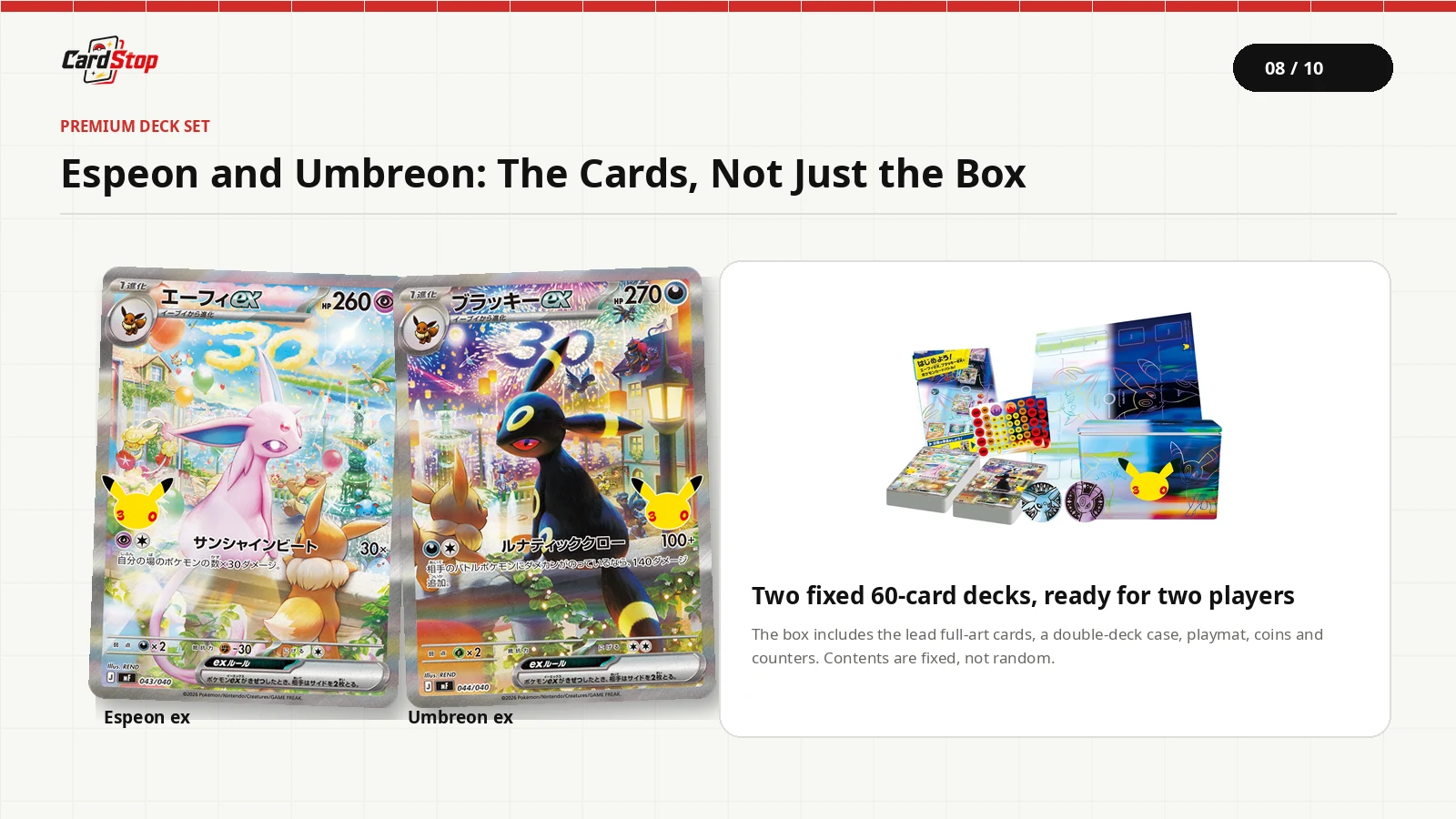
The Premium Deck Set’s clearest attractions are the full-art Espeon ex 043/040 and Umbreon ex 044/040. High-resolution fronts reveal much more than a cropped product photograph. Espeon moves through a bright street scene filled with daylight, balloons and small environmental details. Umbreon crosses a darker setting of lamps, night sky and illuminated windows. Together, the pair creates a complete day-and-night contrast.
The box includes two fixed 60-card decks, one led by Espeon ex and one by Umbreon ex. Fixed contents mean buyers know exactly what they will receive and two beginners can start with the same product. A metal double-deck case, playmat, two damage-counter/marker sheets and two Pokémon coins give it a more complete identity than a basic starter deck.
The full-art cards should not be confused with random M6a pulls. They use the MF set code and come from the Premium Deck Set. When comparing singles later, the number and source product provide a much cleaner identification than a broad search for “30th Espeon” or “30th Umbreon.”
For an Eeveelution collector, the lead cards and coordinated accessories are the heart of the package. For a new player, the two fixed decks remove the first barrier of deck construction. It does not replace M6a because the experiences are different: one is ready to play, while the other is random to open.
09
Nine generations and 27 starter promos at a glance
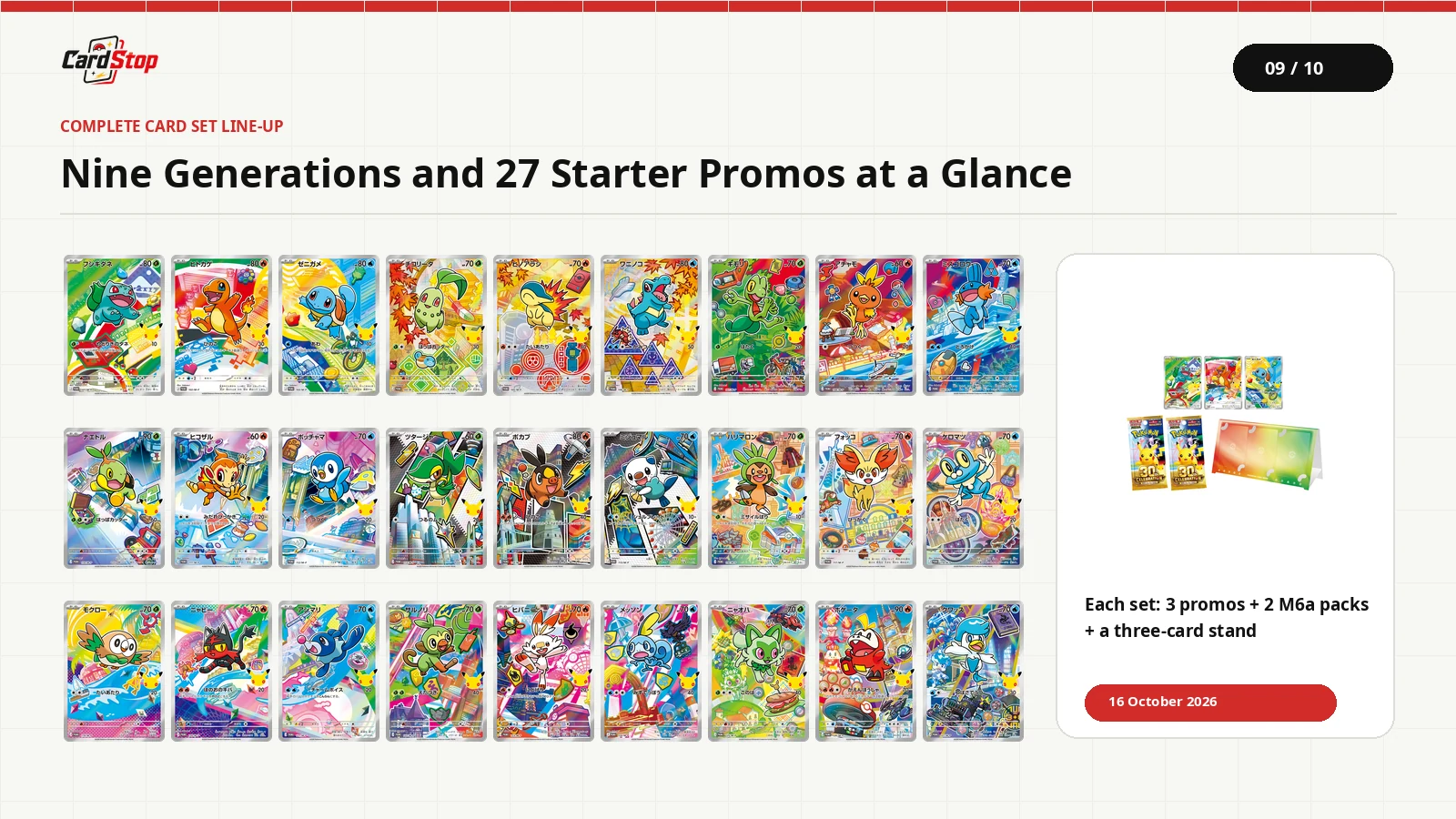
The nine Card Sets launch on 16 October. Each focuses on the three first-partner Pokémon from one generation, giving the trio full-art promos alongside two M6a packs and a paper three-card stand. Across the entire line, that means 27 promos, nine generations and thirty years of personal first choices.
Generations one to three
- Kanto: Bulbasaur, Charmander and Squirtle. The original trio remains the clearest visual link to the franchise’s 1996 beginning.
- Johto: Chikorita, Cyndaquil and Totodile. Their display can sit naturally beside second-generation Legendary cards such as Lugia and Ho-Oh.
- Hoenn: Treecko, Torchic and Mudkip. Strong colour and movement make the trio especially lively when placed together.
Generations four to six
- Sinnoh: Turtwig, Chimchar and Piplup. Their strongly differentiated personalities will be familiar to many players whose first Pokémon game arrived in the Nintendo DS era.
- Unova: Snivy, Tepig and Oshawott. The three cards create a balanced team display with energetic compositions.
- Kalos: Chespin, Fennekin and Froakie. Froakie’s later evolution into Greninja also creates a direct character bridge to Greninja ex in M6a.
Generations seven to nine
- Alola: Rowlet, Litten and Popplio. Rounded character designs and brighter scenes give the trio a relaxed, playful mood.
- Galar: Grookey, Scorbunny and Sobble. Their very different expressions and movement create an almost animated sequence.
- Paldea: Sprigatito, Fuecoco and Quaxly. As the ninth-generation endpoint, the trio makes the thirty-year distance most visible when displayed beside Kanto.
The Card Set line offers a clear collecting target. A fan can buy one favourite generation or build the full nine-set display. Because the three promos are fixed, there is no random chase for the starter trio; the two M6a packs simply preserve a small opening experience.
The paper stand is designed to keep all three promos in one sightline. Long-term display still needs basic care: avoid direct sunlight and high humidity, use sleeves that fit the stand properly, and check that the cards are not being bent by a holder that is too tight.
10
A practical buying guide for Hong Kong readers
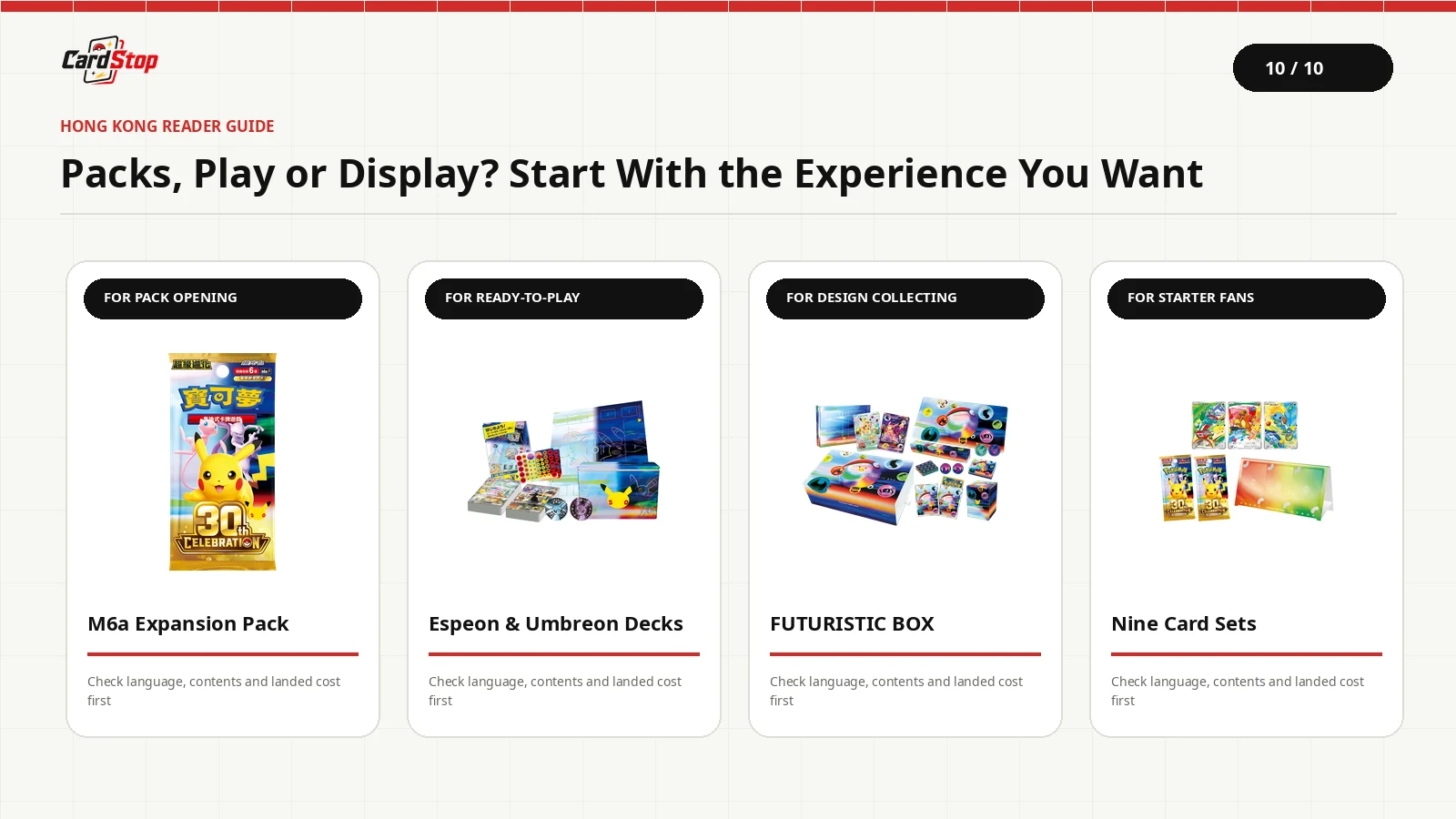
Anniversary releases invite urgency. Words such as “limited,” “lottery” and “first allocation” can make every product feel like an immediate decision. Four simple checks prevent most mistaken purchases.
Decide whether you want packs, play or display
Choose M6a for random openings. Choose the Premium Deck Set when two people want to play immediately. Consider the Futuristic Box if the YOSHIROTTEN design system and premium accessories are genuinely the goal. Wait for the October Card Sets when a specific starter generation matters most. The same 30th Celebration branding does not make the contents substitutes for one another.
Check language, set code and card number
Hong Kong receives a Traditional Chinese M6a release while Japanese products also circulate locally. The same illustration can carry different market prices when the language, product and number change. A single-card listing should identify at least the language, set code, card number, rarity and promo status.
The Espeon and Umbreon full arts use MF numbers. The Futuristic Box Pikachu ex cards use M-P promo numbers. The M6a FUR cards are numbered 134/103 and 135/103. These details are faster and safer than identifying a card only by its character and anniversary label.
Compare the landed cost, not one headline price
Japanese suggested retail is not the final Hong Kong cost. Proxy fees, shipping, exchange rates, lottery arrangements and supply all affect the amount paid. A comparison should put those figures together rather than using one low screenshot as the entire story.
Launch-week single-card asking prices can also change quickly. Completed sales, card condition and clear photographs normally provide a more useful reference than one seller’s highest listing.
Protect the card before studying it
Reflective FUR, SAR and gold reprint surfaces reveal fine scratches easily. Use a clean soft sleeve immediately, then a rigid or semi-rigid holder for important cards. Avoid pressing a finger against the surface while taking photographs.
If grading is a future option, inspect corners, edges, surface and centring before submitting. Anniversary attention does not make every card a sensible grading candidate. For most collectors, safe storage and easy viewing will matter more than chasing a predicted number.
Collectors bringing duplicates to a trade meeting can separate the trade pile from the personal collection in advance and use removable number labels on the outer sleeve. For higher-value exchanges, request clear front-and-back images and inspect the physical card in good light before paying. The louder the anniversary conversation becomes, the more useful it is to separate liking the art from rushing a transaction.
CONCLUSION
The best anniversary entry point is personal
Charizard and Lugia may recall a first encounter with Pokémon cards. Another collector may follow the thirty Pikachu illustrators. Someone else will be drawn to YOSHIROTTEN’s FUR language, while two friends may simply want to play an Espeon-versus-Umbreon game from one box.
30th Celebration does not force every reader toward one “most valuable card.” Its range lets people choose how they want to remember the anniversary. After launch, the most interesting story will be the completed card list, the full thirty-card Pikachu gallery, the remaining classic returns and the physical quality of each language edition—not one first-day asking price.
Understand the product first, then choose the character, artist or play experience that genuinely matters. That is how an anniversary purchase becomes a collection with a personal memory rather than another unopened item on a shelf.
FAQ
Frequently asked questions
When does M6a 30th Celebration launch in Hong Kong?
The official Traditional Chinese page lists a worldwide release on 16 September 2026 and a Hong Kong suggested retail price of HK$25 per pack.
How many cards are in an M6a pack?
Six foil cards. One special Basic Energy and one card from the 30-artist Pikachu project are guaranteed; the remaining four cards are random.
Does every pack contain a FUR or classic reprint?
No. The only stated guarantees are the Basic Energy and anniversary Pikachu. FUR, SAR, AR, Pokémon ex and classic reprints remain random.
Does the Futuristic Box contain M6a packs?
The official contents list does not include booster packs. Its headline items are two Pikachu ex FUR promos, sleeves, mat, cases, metal markers and display accessories.
Are the classic reprints legal in the current Standard format?
The official page says the special reprints cannot be used directly in the current Standard format. They can only be played where the rules allow the original card.
Have all thirty Pikachu illustrations been revealed?
The official project confirms thirty cards and one guaranteed Pikachu per pack. As of 31 August 2026, twenty fronts appear in the official list, with the remaining designs still to be added.
Where do the full-art Espeon and Umbreon cards come from?
They are fixed contents of the Espeon & Umbreon Premium Deck Set, numbered MF 043/040 and MF 044/040. They are not random M6a cards.
How this guide was verified
Official product pages and card lists take priority. Launch facts, fixed contents, random cards and unrevealed designs are kept separate.
- Check official launch dates and suggested prices
- Match product contents and card numbers
- Use card backs—not leaked art—for unrevealed designs
METHOD / SOURCES
Sources
Cardstop Editorial checked this guide against official Pokémon and Pokémon Card Game product pages. Reveal status is current to 31 August 2026.
- Traditional Chinese official | M6a 30th Celebration
- Japanese official | M6a 30th Celebration
- Japanese official | Espeon & Umbreon Premium Deck Set
- Japanese official | 30th Celebration Futuristic Box
- Japanese official | 30th Celebration Card Set
- Japanese official | YOSHIROTTEN artist profile
- Pokémon official | 30th-anniversary information


