Open one of these services on a phone and the first things on screen are usually headline cards, reveal animations, countdowns and the number of pulls remaining. After a result appears, the user may request delivery of the physical card or give it up for a value set by the platform, receiving points that can be spent in another pool. This has become a familiar journey in Japan's online Oripa market: the appeal of physical trading cards remains, while payment, reveal, conversion and repeat spending are compressed into a matter of moments.
Oripa is derived from the Japanese term 'original pack' (オリジナルパック). It is a pack assembled by a card shop or platform, rather than an official product issued by the manufacturer of the underlying cards. In the physical era, a buyer at least left with a pack of cards. In the web-app era, users first buy Coins, PT, Points or Credits, receive a digital result, and only then decide whether to ship the item or exchange it for platform value. This draw-convert-draw-again loop—not an official Pokémon or ONE PIECE booster product—is the subject of this report.
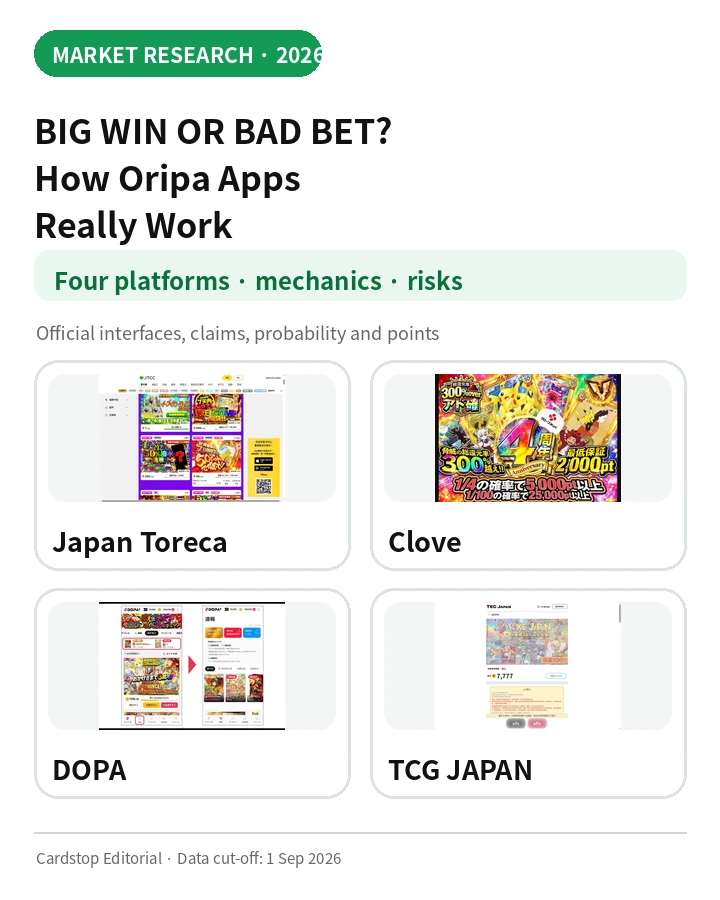
The comparison covers four services often discussed among Japanese and Chinese-speaking collectors: Japan Toreca (日本トレカセンター), Clove, DOPA and TCG JAPAN, listed without ranking. They are not an exhaustive list of the global market. Nor can their scale be ranked simply by adding registration claims: each company reports users, revenue and service coverage on a different basis.
Key Findings
- Japan's overall retail card-game and TCG market reached JPY338.414 billion in 2025. That is not the size of the Oripa segment, for which no reliable official split of the four platforms' combined revenue or market share is available.
- Japan Toreca's 'offering ratio' is a complete opening inventory table, while higher-tier prize history appears after a pool closes. Both improve traceability, but neither is a complete live-odds display while sales are in progress.
- Clove has turned continuation probability, staged reveals and leaderboards into the RUSH brand. A displayed 98% describes continuation—not a 98% chance of breaking even—and Clove states that the products are already determined when a RUSH ticket is obtained.
- DOPA links winner alerts, post-sale S-prize positions, Rank and Jackpot tickets. The same features can add transparency while also creating reasons to keep spending.
- Some TCG JAPAN pools disclose an initial probability for every item. A claim such as '70% winning rate' still cannot be read as a 70% chance of profit when the qualifying threshold is not defined.
- Nominal total return is usually a whole-pool average calculated with values set by the platform, not a cash investment return. Points may also expire, cannot be withdrawn, and remain subject to shipping and exchange rules.
Contents
01
Four Platforms, Four Corporate Profiles: What the Public Record Shows
Comparing features by platform name is straightforward; comparing corporate scale is much harder. All four operators are privately held Japanese companies, and only fragments of statutory accounts or financing announcements are public. None provides revenue, active paying users, gross merchandise value, prize procurement costs and outstanding point liabilities on a common basis sufficient to calculate Oripa market share. The profiles below separate official registrations and statutory notices from company claims and genuine unknowns.
Japan Toreca (日本トレカセンター): published accounts show profit, but not revenue
Japan Toreca is operated directly by Japan Toreca Center Co., Ltd., a Japanese company incorporated in April 2023 under CEO Toshihiro Oyama. Japan's G Biz INFO database records 131 people covered by social insurance, while the operator's commercial-law page lists a second-hand dealer permit from the Tokyo Metropolitan Public Safety Commission. Public records do not identify a listed parent company or provide a complete shareholder register.
Third-party reproductions of statutory notices show net profit of about JPY224 million and total assets of about JPY623 million for the first period, which ended in November 2023 after roughly seven months. For the third period, ending November 2025, they show net profit of about JPY2.359 billion and total assets of about JPY6.937 billion. Between those disclosed periods, profit rose to roughly 10.6 times its earlier level and assets to about 11.1 times. The second period is missing, however, and the notices do not disclose revenue, GMV, prize costs or pool-level economics. Company profitability cannot be reverse-engineered into the result for an individual user.
Recruitment materials have referred to millions of users, 99.9% of sales coming from online Oripa and annual revenue in the tens of billions of yen. These remain company-reported indicators whose user definition—registered, verified, paying or active—is not stated. This report treats them as clues to scale, not as a ranking metric.
Clove: TrustHub reports JPY2.4 billion in cumulative financing, but no operating revenue
Clove Oripa is operated by TrustHub Inc. (株式会社トラストハブ), led by CEO Goki Ogata. TrustHub was established in 2019, and Clove Oripa launched around the middle of 2022; official materials differ by one month, citing June or July. The corporate site reports 33 full-time employees, capital of approximately JPY99.5 million and cumulative funding of JPY2.4 billion.
The clearest financing records include a JPY350 million Series A in 2021 and JPY1.7 billion of bank borrowing and commitment lines announced in 2024. The latter is debt and standby capacity, not revenue, and it does not mean the entire amount has been drawn. TrustHub does not publish full revenue or a Clove Oripa segment breakdown. A third-party compilation of statutory notices reports net profit of about JPY358 million and total assets of about JPY3.628 billion for the year ended April 2025; this is not the equivalent of a listed-company annual report audited and filed through EDINET.
A 2026 fourth-anniversary announcement said cumulative membership had passed 1.1 million. That is a company-reported cumulative account figure, not monthly active users, paying customers or verified unique people. Nissay Capital is a known investor and should not be described as the parent company.
DOPA: sinsa has not disclosed revenue, profit or ownership details
DOPA is operated by sinsa Inc. (株式会社 sinsa), represented by Ryo Hasegawa. The company was incorporated in July 2022, is unlisted and records stated capital of JPY1 million. Registered capital is an incorporation detail; it is not equivalent to cash on hand, inventory value or the ability to meet obligations.
As of the data cut-off, the company site and government registry did not disclose a verifiable parent, complete shareholder list, funding round, revenue or profit. DOPA says cumulative users exceed 1.5 million and cites Sensor Tower data in claiming leadership in average MAU and downloads among Japanese Oripa apps. Because the competitive set is defined by the company, this should be reported as a market claim based on third-party data, not as an independently established ranking.
TCG JAPAN: the platform and physical store list different entities; their formal relationship is undisclosed
The commercial-law page for the Oripa service at tcg-japan.com still names 2style LLC (合同会社2style) and Someya Jyunki. The physical card store launched at store.tcg-japan.com in 2026 names Trading Card Japan Co., Ltd. (Trading Card Japan 株式会社), also represented by Junki Someya. The newer company was incorporated in February 2026 and shares obvious links with 2STYLE through its published representative and address.
No formal announcement was found confirming a business transfer, parent-subsidiary arrangement or ownership relationship between the two. The newer company therefore should not automatically be presented as 2STYLE's parent or subsidiary. Neither private company publishes verifiable revenue, profit, active users, GMV, market share or financing data. Separately, 2STYLE sells the ORIPAL white-label system to other card shops, indicating that it is both a platform operator and a technology supplier.
| Platform / operator | Verifiable financial or scale information | Main limitation |
|---|---|---|
| Japan Toreca / Japan Toreca Center | Statutory notice reproduction: Nov 2025 profit JPY2.359bn, assets JPY6.937bn; company reports millions of users | No revenue, GMV or pool-level economics; user definition unclear |
| Clove / TrustHub | Company reports JPY2.4bn cumulative funding; statutory notice reproduction: Apr 2025 profit JPY358m, assets JPY3.628bn; 1.1m cumulative members | Funding is not revenue; no Clove segment revenue or MAU |
| DOPA / sinsa | Company reports 1.5m cumulative users and cites Sensor Tower for market claims | No public revenue, profit, financing or ownership detail; comparison set defined by company |
| TCG JAPAN / 2style and related entity | Operator registrations are available; a white-label system and physical card store also exist | Relationship between old and new companies not formally explained; no revenue, user or funding data |
Editorial method: statutory figures and company-reported claims are shown separately; no estimate is made where public data is absent. Figures are rounded.
02
Japan's TCG Market Reaches JPY338.4bn, but Official Oripa Data Remains Scarce
Annual figures from the Japan Toy Association show that Japan's retail card-game and trading-card-game market grew from about JPY96.067 billion in 2015 to JPY338.414 billion in 2025. The market rose by roughly 11.9% year on year in 2025 and accounted for around 30% of Japan's toy market. A decade of expansion helps explain why card shops, apps, livestreaming, consignment services and cross-border logistics have all developed around trading cards.
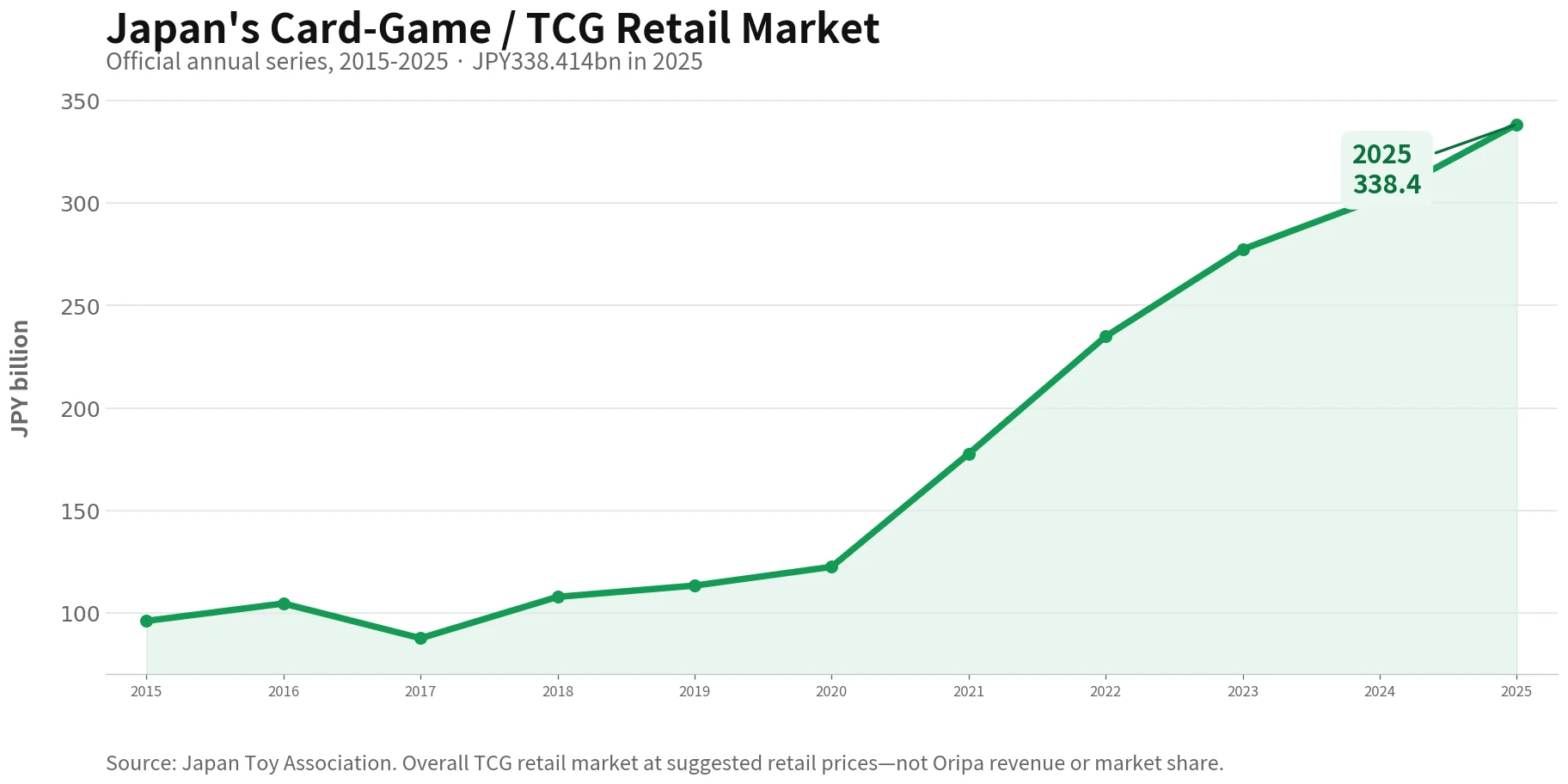
That line cannot be treated as an Oripa-industry revenue curve. The association estimates the overall card-game and TCG market at manufacturers' suggested retail prices, including official booster packs, constructed decks and other standard products. It does not separately identify online Oripa, secondary-market cards, point conversions or platform fees. The four operators' membership claims cannot simply be added either: one person can register with several platforms, and 'cumulative members' are not the same as active paying users.
03
From Top-Up to Another Draw: How the Four Platforms Keep Points in Circulation
The interfaces, reveal animations and membership systems differ, but the underlying flow is strikingly similar across the four services: users buy platform currency with cash, spend it on a finite or configured pool, see a digital result, then choose between physical delivery and surrendering the item for a platform-set number of points. Those returned points cannot be withdrawn as cash, making another draw their most obvious use.
| Stage | What the user sees | What the consumer should verify |
|---|---|---|
| 1 | Top up | HKD, JPY or USD becomes Coins, PT, Points or Credits | Exchange rate, minimum top-up, expiry, refund and card-dispute terms |
| 2 | Choose a pool | Headline prizes, return rate, continuation rate, pulls remaining and countdowns | Is the number opening-time or live? What qualifies as a 'win'? |
| 3 | Reveal | Animation, visual effects, continuing challenges, rankings and winner alerts | Does the animation represent a fresh random event? Are only large results shown? |
| 4 | Resolve | Ship the physical item or convert it to platform points | Delivery deadline, freight, tax, condition, platform valuation and conversion ratio |
| 5 | Draw again | Points remain in the account for another pool or membership task | Do non-withdrawable balances and expiry encourage extra spending merely to use them up? |
This closed-loop points design has two important effects. First, the value assigned by the platform may not be tested against public transactions, yet it directly determines what a user receives for giving up the physical item. Second, an instantly restored balance can make prior spending feel less final. The apparent value remains visible until the points are spent again or expire, even though the cash has already left the user's account.
04
Comparing the Four Platforms: Distinctive Features and Disclosure Gaps
4A | Japan Toreca: opening inventory is disclosed, with prize history after sell-out
On 19 August 2026, Japan Toreca added two notable disclosure tools for pull-count Oripa. The 'offering ratio' shows the pool's opening number of pulls and the original quantity and percentage for every tier and item; all listed quantities should add up to the total. 'Prize history' becomes available after the pool sells out or stops trading, showing the pull position and date for first- to third-tier prizes, Last One and numbered-position awards. The company says the record has no publication time limit.
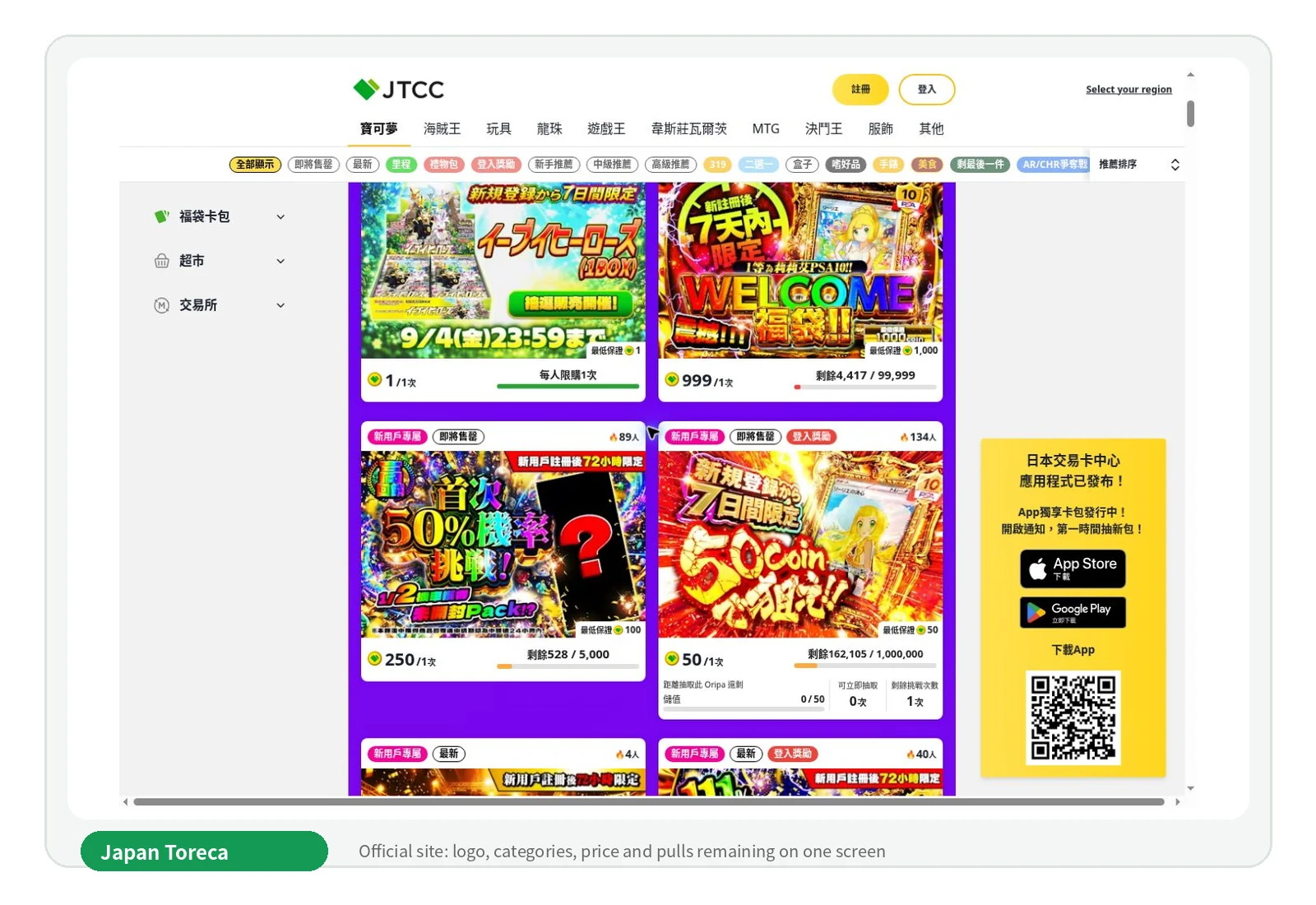
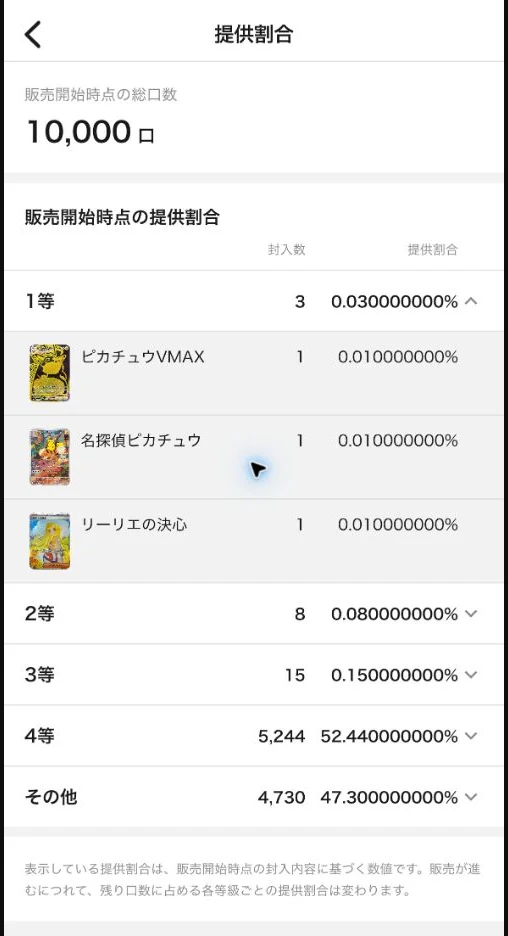
The benefit is that a consumer can audit the opening composition rather than seeing only a handful of headline cards; after sell-out, higher-tier outcomes can be traced to a pull number and date. Among the four services reviewed, this combination of an opening inventory table and post-pool traceability is particularly distinctive. DOPA also offers winner alerts and post-sale S-prize positions, and other platforms show total pulls or initial probabilities, so it would be inaccurate to call the approach unique to the industry.
The principal limitation is that neither tool necessarily answers the decisive question during a sale: are the top prizes still in the pool? Japan Toreca says the offering ratio is calculated from the opening composition. A live page can show the overall number of pulls remaining without updating every headline prize still available. Prize history appears only after the pool closes. The system is therefore an auditable opening inventory plus retrospective record, not a complete live-odds screen.
Official pool 109126 provides a useful example. At launch, 100 of its 200 pulls were listed at 47,100 Coins or above, so the advertised opening probability of one in two could be checked against the composition table. On 1 September 2026, the remaining count moved from 48 to 47, yet the page did not say how many of those original 100 higher-value outcomes remained. The next-pull probability could not therefore be reconstructed. In another 'PSA 9 guaranteed' pool, all 300 pulls were listed as PSA 9. The guarantee had concrete compositional support, but covered category and platform-assigned Coin value—not profitable resale in Hong Kong.
4B | Clove RUSH: 98% is a continuation rate, not a 98% chance of breaking even
Clove's most recognisable format, RUSH, does not simply publish one headline-jackpot probability. A user first obtains a designated ticket from an ordinary Oripa pool and then uses it to enter a continuing challenge. Each successful animated stage adds another item, with the final screen showing the total number of continuations and products received. Clove's official Traditional Chinese guide breaks the process into obtaining a ticket, entering RUSH, continuing successfully and receiving the products.
The format turns a single result into an extended challenge: users focus on how long the sequence continues as well as what they receive. A leaderboard gives exceptional runs a shareable place on the page. Yet the official note also says that the products dispensed are already determined when the RUSH ticket is obtained. The staged animation is primarily a reveal of a predetermined bundle and should not be assumed to represent a fresh random draw at every visual checkpoint.
| Pool example | Figures at the cut-off | How to interpret them |
|---|---|---|
| Infinity 98% RUSH | Ticket entry: 8,000 Coins; leaders at 656, 535 and 534 continuations; prizes from SAR cards and boosters to damaged cards | 98% is the displayed continuation condition, not a break-even rate; the ranking lacks total entrants, median and full distribution |
| Happy 95% RUSH | Ticket entry: 8,100 Coins; leaders at 215, 214 and 212; includes PSA items, boosters, AR and random cards | A three-point difference produces a large difference in an ideal model's tail; item value and full ticket cost still matter |
Official dynamic RUSH pages | Data cut-off: 1 September 2026. Ticket prices, leaderboards and prize lists may change.
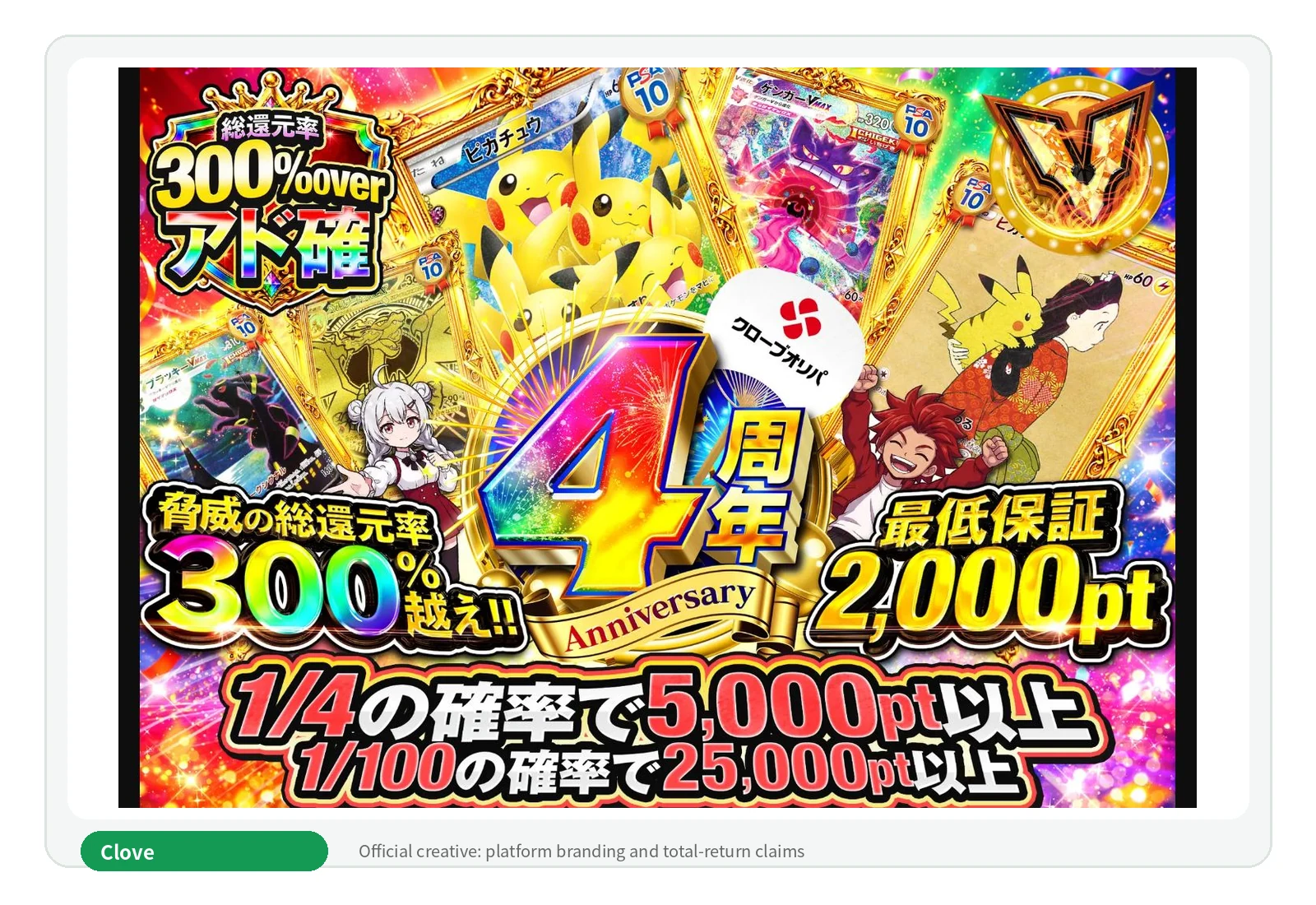

Clove's own qualification of return-rate claims is relatively direct. The rate is calculated as the theoretical value of buying the entire pool and does not guarantee equal value on every pull; displayed probabilities are also opening-time theoretical values that change as items are dispensed. A fourth-anniversary campaign advertised a 20-million-pull pool with a nominal total return of 302.8%. That was a whole-pool ratio based on platform-set points—not 302.8% returned to each player and not a cash investment yield.
4C | DOPA: Rank, Jackpot and winner alerts reinforce a continuing-spend loop
DOPA's differentiation lies less in one coupon than in the way Rank, Jackpot tickets, winner alerts, post-sale results and time-limited pools form a longer retention path. Seven Rank levels progress according to PT spent during the month and reset on the first day of the next month; higher levels carry minimum monthly-payment requirements, while Master is invitation-only. From Bronze, users can unlock Bonus Packs, point-purchase bonuses and Jackpot events, although some high-return or high-continuation pools do not count towards Rank or the Jackpot gauge.
A Jackpot ticket is not, by itself, a free draw. On 1 September 2026, the 'Moon Viewing Lucky Bag' required 100 tickets plus 18,000 PT, while the 'Moonlight Lucky Bag' required 100 tickets plus 30,000 PT. Higher tiers reached 5,000 tickets plus 650,000 PT. Tickets record eligibility accumulated through earlier spending, yet exercising that eligibility still requires additional PT: spend first, accumulate access, then spend again.
STream CARNIVAL illustrates why its promotional measures must be separated. Each pull cost 12,830 PT; the pool opened with 2,000 pulls and had about 400 left at review. Its artwork simultaneously advertised a 97% total return, a 90% continuation rate and a 90% chance of receiving 13,500 PT or more, yet the minimum guarantee was only 2 PT. The 97% was a nominal whole-pool average, the 90% was a platform-defined threshold rate, and 2 PT was the single-pull floor. Two divided by 12,830 is approximately 0.0156%, showing how a tiny minimum guarantee can coexist with a high continuation claim.
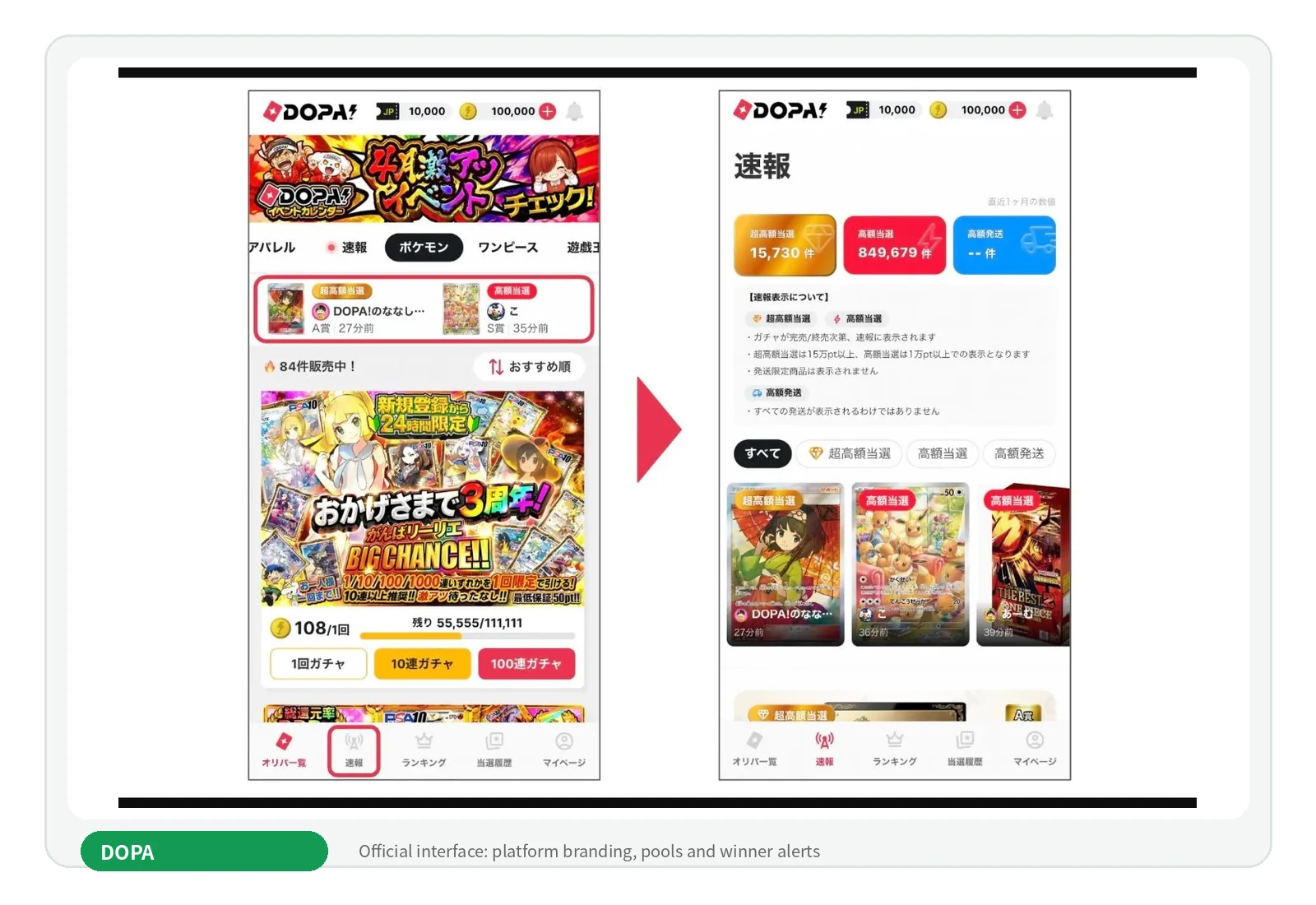
DOPA's transparency advantage is that its alert feed identifies selected high-value wins, the card, time and username; after sell-out, users can also view where S prizes appeared. But alerts show a selected set of high-value outcomes without listing every ordinary pull as the denominator, and a post-sale record is not a complete live inventory. The same feature can make results more visible while turning 'someone just won' into a social signal for the next user to enter.
4D | TCG JAPAN: initial probabilities are visible, but the 'winning' threshold is not
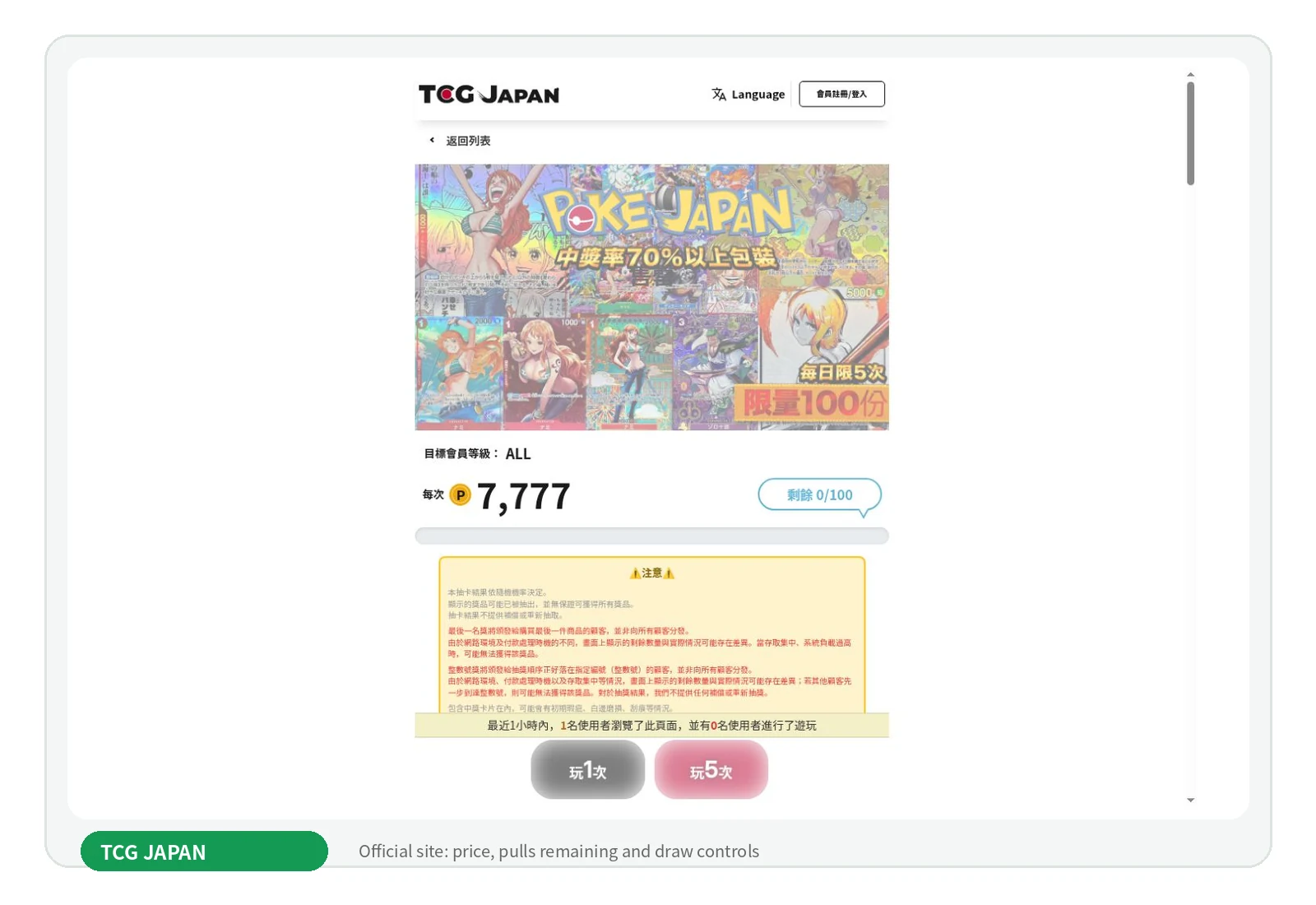
TCG JAPAN Oripa pages commonly show total and remaining pulls and, for some pools, the opening probability of each item. They also use Last One, numbered-position prizes, monthly top-up rankings and random flash sales. A related physical-card store adds daily, weekly and monthly candlesticks, Open, High, Low, Close, volume and moving averages. Combining a draw entry point with physical-card market charts is unusual among the four services. The source of the pricing data, the definition of volume and whether only in-store transactions are counted are not fully explained, however, so the charts cannot automatically be treated as a fair cash-out price in Hong Kong.
The live example lists 16 cards across a 100-pull pool, with individual probabilities that add to 100%. Receiving some result is therefore guaranteed. What the page does not clearly define is which 70 pulls qualify as a 'win': whether they exceed the 7,777-point cost on the platform's valuation, sit above a specified tier, or merely exclude certain lower-value cards. Readers cannot reconstruct the 70% threshold from the probability table alone, much less establish a 70% chance that the item's net Hong Kong resale value exceeds the cost.
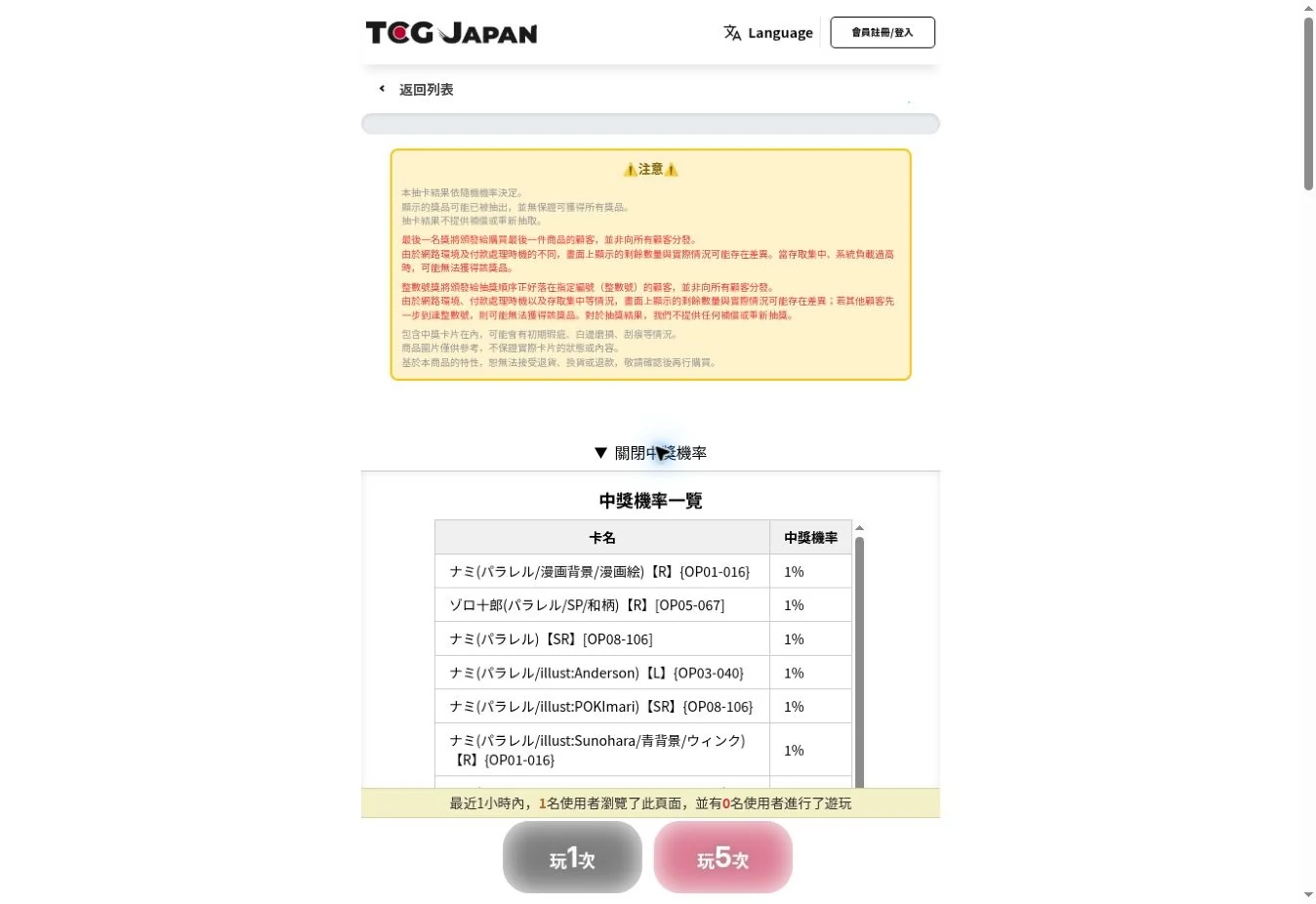
A second live example, 'Storm Emeralda 12', opened with 2,000 pulls. The page listed one MUR card at 0.05% and two booster boxes at 0.1%, with about 517 pulls remaining at review. Its terms nevertheless say that displayed prizes may already have been drawn. The page shows the opening composition and overall inventory left, but not the live remaining quantity of each prize or a winner history. TCG JAPAN is comparatively transparent about initial composition, not completely transparent about live odds.
There is a further corporate information gap. The Oripa commercial-law page names 2style LLC; the newer physical store is operated by Trading Card Japan Co., Ltd., incorporated in 2026. Their shared address and representative indicate a close connection, but public pages do not formally explain a transfer of operations or corporate relationship.
05
95%, 133% and 'Guaranteed': What the Promotional Numbers Actually Mean
An Oripa promotional number may be factually accurate while using a denominator quite different from the one a consumer assumes. '95%' might describe continuation, the share of outcomes above a platform-point threshold, or the opening allocation of a prize tier. None automatically means a 95% chance of recovering the cost. Every percentage should be read with its numerator, denominator and valuation method.
| Promotional phrase | More accurate reading | What cannot be inferred |
|---|---|---|
| 95% / 98% RUSH | Theoretical continuation under specified conditions; Clove separately says products are determined when the ticket is obtained | Not a 95% / 98% chance of breaking even, making a profit or winning the top prize |
| 97% / 133% / 302.8% total return | Platform-set value of the whole pool at launch divided by the total cost of all pulls | Not the same ratio returned on each pull and not a cash yield |
| 70% or higher winning rate | Share that meets the platform's own definition of 'winning' | Without a disclosed threshold, it cannot be read as a 70% chance of profit |
| Guaranteed / minimum guarantee | Every pull receives a stated item category or at least a platform-point floor | Does not guarantee value above cost, resale at face value or acceptable condition |
| PSA 10 / BOX guaranteed | The result matches the named item class or grade | Does not guarantee a particular card, appreciation, liquidity or a Hong Kong market price |
| Last One / numbered-position prize | A conditional award tied to the final purchase position or a specified sequence number | Not an identical independent probability on every pull |
5A | A nominal total return of 133% can still leave most pulls below cost
Japanese pages often use the phrase sōkan-genritsu (総還元率). In English, 'nominal total return' or 'whole-pool displayed value ratio' is less misleading than an unqualified 'return on investment'. A useful general interpretation is that the platform adds its assigned point value for every prize at launch, then divides that amount by the price per pull multiplied by the total number of pulls. It is a whole-pool, opening-time ratio denominated in platform value.
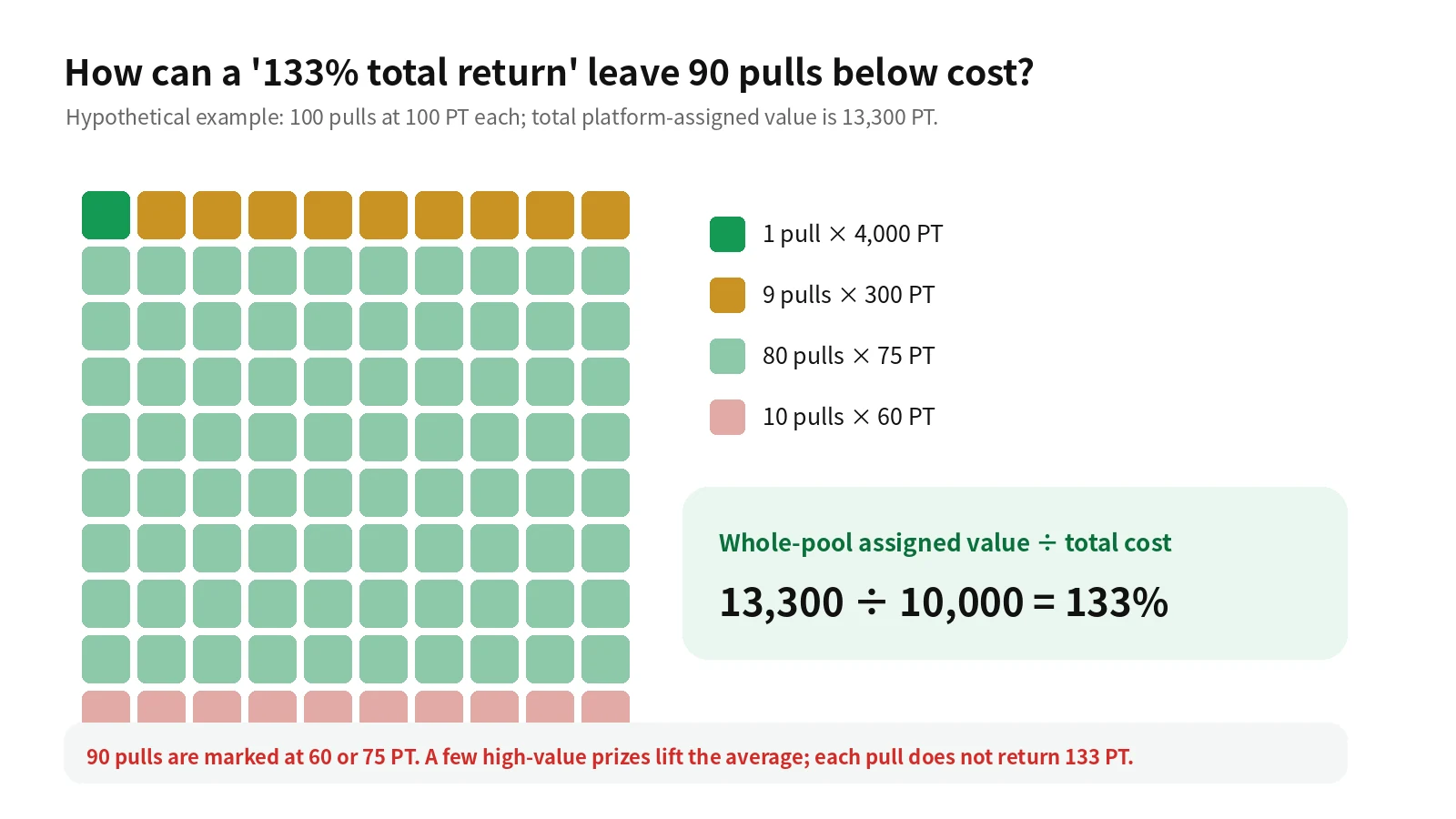
The figure is a mathematical illustration, not a platform pool: 100 pulls cost 100 PT each; one outcome is marked at 4,000 PT, nine at 300 PT, 80 at 75 PT and ten at 60 PT. Total displayed value is 13,300 PT, giving a nominal total return of 133%. Yet 90 outcomes are worth only 60 or 75 PT. A small number of expensive prizes lifts the average; it does not turn every outcome into 133 PT, and one consumer cannot repeatedly reproduce the whole-pool average under identical conditions in a finite pool.
Clove's fourth anniversary featured a 302.8% claim, and its release referred to daily pools above 120% and a maximum of 300%. DOPA has promoted 118%, 105% and limited pools above 400%. Japan Toreca has used wording equivalent to 'total return above 100%'. These can be correctly calculated promotional pools, but the necessary follow-up questions remain: who set the values, how much value is concentrated in top prizes, how much of the pool has already been drawn, can points be withdrawn, and is the offer a short, tightly limited promotion?
5B | A 95% continuation rate is not close to certainty over many rounds
In an idealised model where every stage is independent and the continuation rate remains fixed, the probability of passing n stages is p to the power of n. At 95%, the chance of continuing through 20 stages is about 35.9%, through 50 about 7.7% and through 100 about 0.59%. At 98%, the corresponding figures are about 66.8%, 36.4% and 13.3%. In this model, the mean is approximately 19 at 95% and 49 at 98%; a mean is not a guaranteed run length.
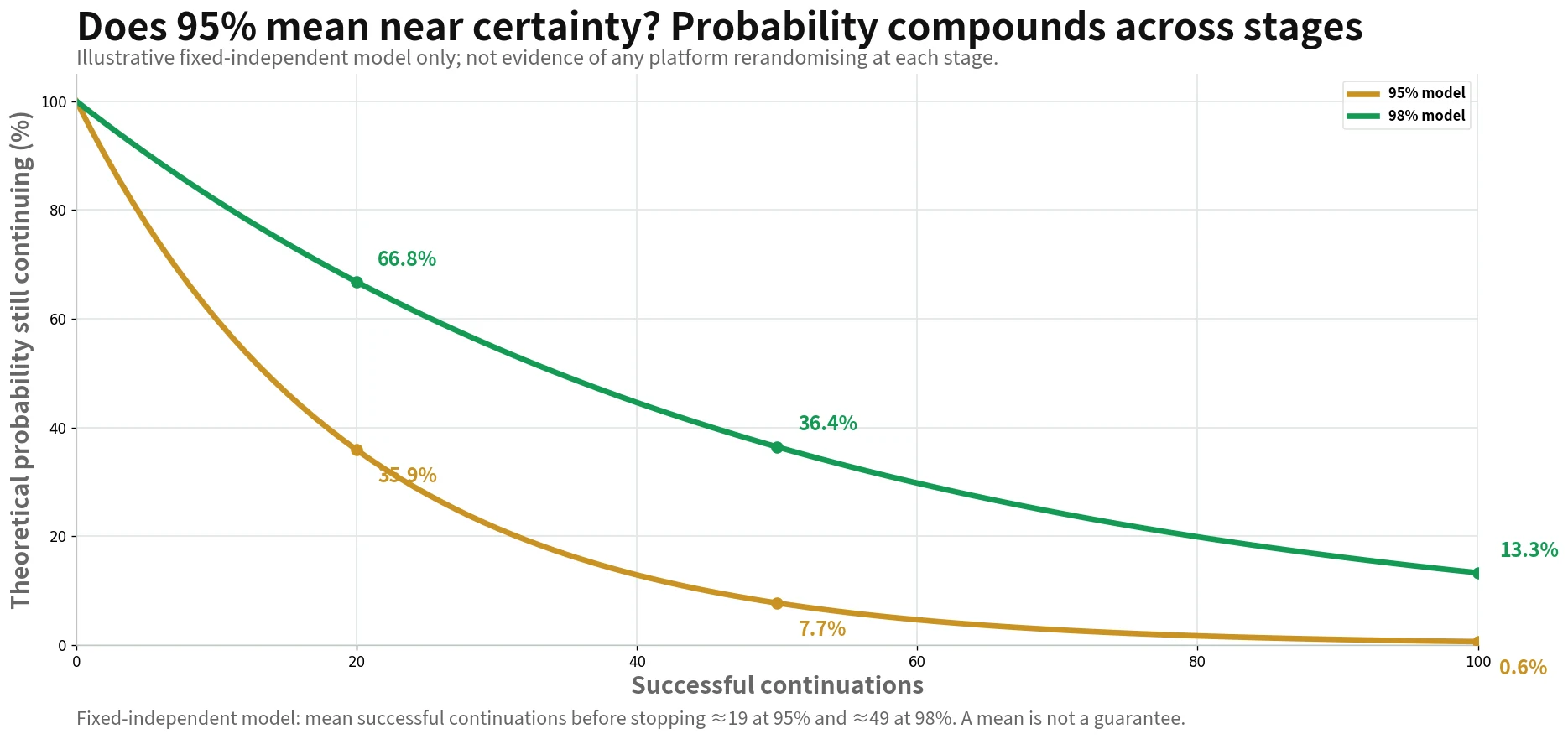
Clove's actual rule adds a crucial qualification: it says the products are already determined when a RUSH ticket is obtained. The graph is not evidence that its system runs a new random event at every stage. It illustrates one intuitive point only—apparently high single-stage success rates still multiply across long sequences. Even a long sequence says nothing by itself about whether the items are worth more than the total cost of obtaining the ticket.
5C | Before reading a 'winning rate', define the qualifying threshold
Every paid draw produces a result. If receiving any card counts as 'winning', a platform can formally claim a 100% winning rate. If only outcomes valued above the pull price count, the numerator changes completely. The item probabilities in TCG JAPAN's 70% example add to 100%, but the screen does not identify which 70 positions meet the winning threshold. DOPA's STream CARNIVAL is more specific in linking 90% to outcomes of at least 13,500 PT, yet PT is still a platform value rather than the net price obtainable in Hong Kong.
A minimum guarantee also needs a ratio. If a pull costs 1,000 PT and guarantees 100 PT, the promise preserves one-tenth of the nominal point value in the worst case while still permitting a 90% nominal shortfall. Japan Toreca's 'PSA 9 guaranteed' example promises a PSA 9 item; Clove's PSA 10 or BOX RUSH promises an item class. Neither promises a specified card, rapid resale or profit after costs.
5D | Last One, numbered prizes and leaderboards change how outcomes are framed
Last One is a specified prize awarded at the final purchase position. A numbered-position prize is triggered when remaining inventory crosses a predetermined count. DOPA's official example uses a 500-pull pool with one such prize every 100 positions: the purchaser who moves the count from 401 to 400 receives it, not the purchaser who moves 400 to 399. These awards depend on purchase order, concurrent competition and system timing; they should not be presented as an identical independent probability for every user.
Leaderboards and winner feeds are a different form of disclosure. They can prove that certain high-value or long-run results occurred, but they do not describe the typical user unless total participants, the median, the full distribution and all ordinary draws are also shown. A Clove record of 656 continuations does not imply that an ordinary user can expect the same. DOPA's high-value alerts likewise display selected standout outcomes rather than the complete distribution.
06
Probability and Expected Value: Remaining Pulls Alone Do Not Reveal Live Odds
6A | Opening probability may be auditable without being the next-pull probability
If a finite pool opens with N₀ pulls and R₀ target prizes, the opening probability is R₀ divided by N₀. After sales, the true probability on the next pull is the number r of target prizes still present divided by the remaining N pulls. A platform that shows N but not r does not provide enough information to recalculate live odds.
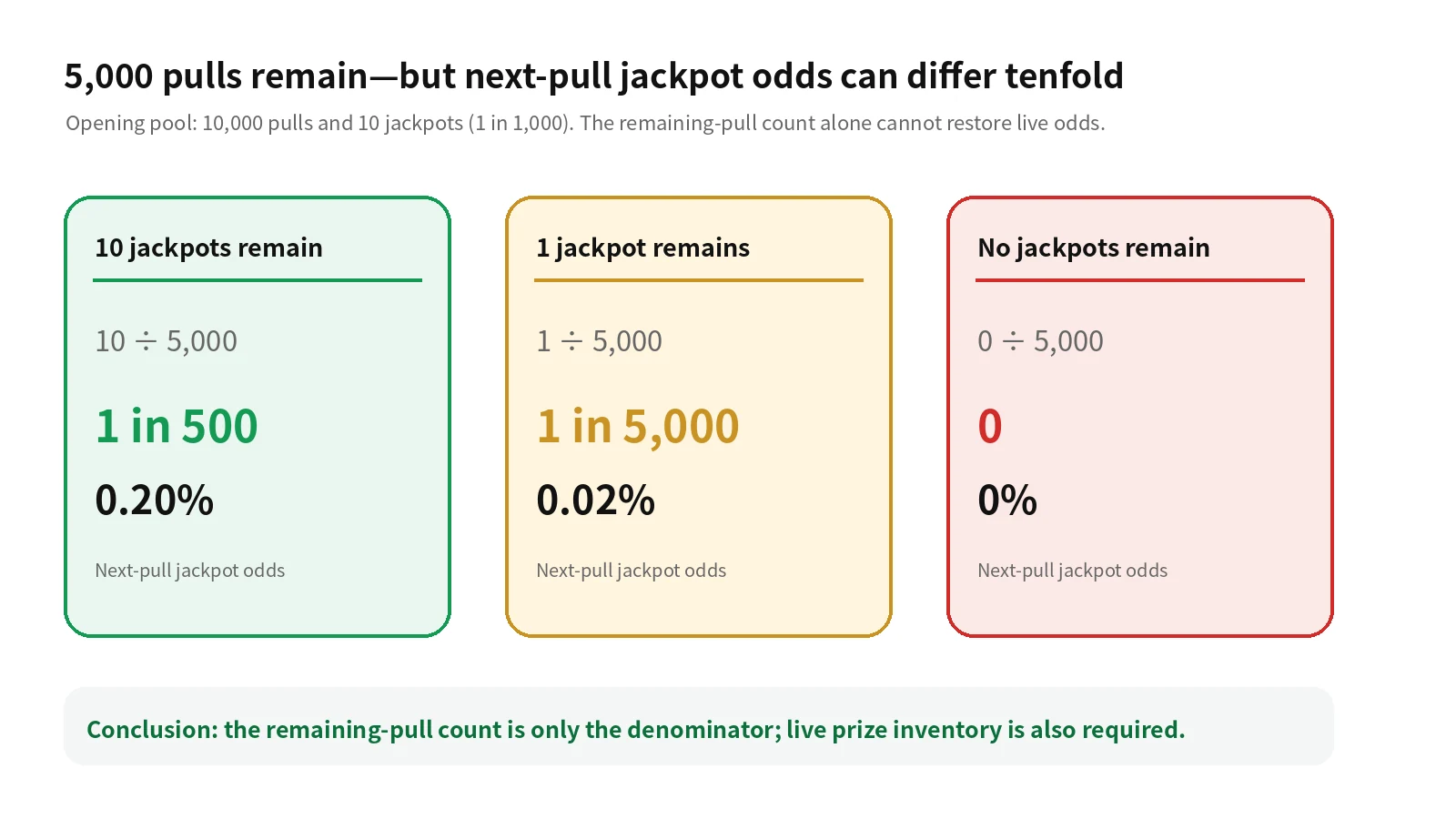
This is the common limitation across the four services. Japan Toreca, Clove, DOPA and TCG JAPAN may disclose total pulls, opening ratios, remaining pulls or selected post-sale records. Unless they update the live remaining quantity of each major prize, the headline artwork and overall count cannot reveal the actual next-pull probability or expected value.
6B | Ten pulls do not mean multiplying the single-pull probability by ten
A finite pool is sampling without replacement. Suppose two target prizes remain among 1,000 pulls. One pull has a 0.2% chance. The correct probability of at least one success across ten pulls is about 1.991%; it is close to, but not exactly, 2%. For a very large pool, or approximately independent draws, 1 − (1 − p)¹⁰ can be used as an approximation. 'Ten-pull' describes purchase quantity; it does not automatically transform a small probability into a guarantee.
6C | Expected platform points and net cash value in Hong Kong are different valuations
Nominal expected platform value is the sum of each probability multiplied by the platform's assigned points. If some items have been removed, it must instead use the remaining quantity of every outcome. A more practical consumer estimate starts with recent achievable sale prices in Hong Kong and subtracts condition discounts, bid-ask spread, platform or auction fees, domestic and cross-border freight, tax, exchange rates, insurance, time and liquidity. An asking price is not a completed sale, and platform points are not cash.
| Valuation level | What it includes | Question it can answer |
|---|---|---|
| Platform-assigned value | Coins, PT, Points or Credits assigned to the prize by the operator | How much in-platform spending power is received for surrendering the item? |
| Market transaction price | Recent verifiable sales rather than one unusually high asking price | What might the item be worth before costs if it is delivered? |
| Net cash-out value | Sale price less condition, fees, transport, tax, time and liquidity discounts | How much cash might the user realistically recover? |
6D | The platform has pricing and information advantages, but public data cannot prove every pool is profitable
Oripa does have a house-and-player structure. The operator sets the pool composition, price per pull, reference valuation, point-conversion ratio and payment flow; the consumer bears outcome variance, resale discounts and the risk of repeated spending. But without complete prize procurement cost, advertising, logistics, point-expiry, redemption, refund and whole-pool sales data, a total-return claim cannot prove that the platform profits on every pool.
A promotional pool may deliberately exceed 100% as a loss leader, and an individual user may draw a high-value card. Conversely, company-wide profit does not establish that every pool is profitable or that every customer loses. The defensible conclusion is narrower: the platform holds the valuation and information advantage and can monetise the overall business through points, membership and repeat purchases. A consumer who treats assigned points as cash is likely to understate the economic cost.
07
Leaderboards, Virtual Points and High-Impact Animation: What Consumer-Risk Research Shows
Oripa combines physical trading cards with digital randomised reveals. It resembles traditional boosters, loot boxes, lotteries and promotional draws in some respects and differs in others. Very little academic work directly samples Japanese or Hong Kong Oripa users. This report therefore does not transfer results from other settings as causal proof about Oripa. The studies are used only to identify potential risks associated with winner feeds, ambiguous probability, virtual points and stimulating reveal design.
Winner feeds can raise consumers' valuation
A 2024 UK randomised experiment involving 617 people tested information presentation in a simplified lottery setting. Showing only selected high-value winning outcomes increased willingness to pay by about 43%; concealing exact probabilities increased it by about 45%; combining the two increased it by about 100%. This was not an Oripa revenue study, but it provides causal evidence that a winner feed and an unclear denominator can together alter how a chance product is valued.
A leaderboard is therefore not, by itself, evidence of transparency. 'Someone won' and 'how likely is the next person to win?' are separate pieces of information. The first becomes informative about the distribution only when all ordinary outcomes are supplied as the denominator.
Virtual points can weaken the salience of cash cost
A 2026 randomised experiment with 753 participants found that using one-for-one virtual tokens instead of showing pounds directly increased willingness to pay by about 4.0% for risky lotteries and 3.9% for ambiguous lotteries; a less intuitive exchange rate did not add a statistically significant effect. The measured effect was modest and does not prove every Oripa user spends more. It nonetheless supports a practical design principle: display local-currency equivalents beside each draw button rather than showing only large Coin or PT balances.
Pack spending correlates with problem gambling, but causation is unresolved
A 2026 study of 1,961 card-game players in English-speaking Western countries found correlations between problem-gambling severity and spending on physical card packs (r=.15), virtual packs (r=.22) and loot boxes (r=.31). A separate 2021 study of 726 people found no significant relationship for physical packs bought in shops and a statistically significant but very small effect for physical packs bought online. Neither sampled Asian Oripa users, and both are largely cross-sectional: they cannot show whether purchasing causes gambling problems or the reverse.
A broader 2021 meta-analysis combined 15 studies and 16,229 participants, finding a correlation of about r=.26 between loot-box spending and problem gambling. Its authors likewise said the direction of causation could not be determined. The evidence should not be used to label every Oripa product as addictive. The more measured interpretation is that frequent random rewards, virtual currency, near-miss presentation and repeat-purchase loops may be particularly attractive to some higher-risk users.
Probability disclosure does not guarantee consumer understanding
In a Chinese survey of 879 participants, 84.6% of the 428 loot-box purchasers had seen probability disclosures, while only 19.3% said disclosure reduced their spending. The data are self-reported and cross-sectional and do not show that disclosure is ineffective. Instead, they suggest that disclosure may still be insufficient when it is buried in small print, limited to prize tiers, detached from a qualifying threshold or not updated for remaining inventory. A UK government evidence review similarly noted inconsistency in placement, wording, tier grouping, item-level probability and dynamic probability.
08
Conclusion: Oripa Is Paid Entertainment, Not an Investment Product
None of the four services merely reproduces a physical mystery bag online. Japan Toreca makes opening composition and post-pool traceability comparatively clear. Clove has turned continuation and leaderboards into the RUSH brand. DOPA links Rank, Jackpot, alerts and sold-out records into a longer loop. TCG JAPAN combines item-level opening probabilities, delivery and physical-card charts under one brand entry point. Each offers genuine product value and each leaves unresolved information gaps.
The most common misunderstanding is not whether a card is genuine, but the point in time and unit to which a value or probability applies. An opening one-in-two probability is not necessarily a live one-in-two chance; 133% whole-pool return is not 133% on every pull; 95% continuation is not 95% break-even; 'guaranteed' is not capital protection; and a leader's 656-stage run is not a typical-user result. When platform points cannot be withdrawn, real outcomes must also account for shipping, condition, transaction fees and the time required to sell.
Consumers who still choose to participate should treat Oripa as paid entertainment. Set a limit that remains affordable even if the entire amount is lost; check the local-currency equivalent before topping up; and do not spend more merely because the next Rank level is close, tickets remain unused or earlier losses feel recoverable. If the result is a card genuinely wanted for a collection, requesting shipment may be preferable to instantly converting it into points and entering another pool.
The value of market research is not to predict the next result. It is to translate the strongest promotional claims into questions that can be checked: How many pulls are in the pool? How many major prizes remain? What counts as a win? Who sets the valuation? When do points expire? What does delivery to Hong Kong cost? The more completely these questions are answered, the closer the consumer comes to a genuinely informed choice.
Frequently Asked Questions
Is Oripa officially issued by the trading-card brands?
No. Oripa means an 'original pack' assembled by a shop or platform. Pokémon, ONE PIECE and other cards inside may be genuine, but the pool composition, price and probabilities are not set by the original card manufacturer.
Does a total return above 100% guarantee arbitrage?
No. It is usually a nominal opening-time ratio for the entire pool based on platform-assigned points. Value may be concentrated in a few top prizes, points cannot be withdrawn, and the figure excludes condition, fees, shipping and market discounts.
Does 95% RUSH mean a 95% chance of breaking even?
No. It describes a continuation condition. Clove also states that RUSH products are already determined when the ticket is obtained. The number of continuations and the final net value of the products are different measures.
Can remaining pulls alone reveal the live jackpot odds?
No. The denominator is not enough; the number of each headline prize still in the pool is also required. When a service publishes only the opening composition or a post-sale record, the next-pull probability during the sale may remain impossible to calculate.
Does 'guaranteed win' mean there is no risk of loss?
No. 'Guaranteed' may mean only that every pull receives a low-value item, a particular grade or a minimum number of platform points. The guarantee must be compared separately with the pull cost and achievable net resale value in Hong Kong.
Sources
- Japan Toy Association: 2015-2025 market statistics
- Japan Toreca: official announcement on offering ratios and prize history
- Japan Toreca: Specified Commercial Transactions Act disclosure
- Japan G Biz INFO: Japan Toreca Center Co., Ltd.
- Reproduction of statutory accounts: Japan Toreca Center, first period
- Reproduction of statutory accounts: Japan Toreca Center, third period
- Clove: official Traditional Chinese RUSH guide
- Clove: live Infinity 98% RUSH example
- Clove: once-daily RUSH ticket pool and official qualification
- Clove: official fourth-anniversary announcement
- TrustHub: company information
- TrustHub: 2024 financing announcement
- Compiled statutory-account notices: TrustHub
- DOPA: official FAQ
- DOPA: live STream CARNIVAL pool
- DOPA: announcement of winner alerts and sold-out results
- Japan G Biz INFO: sinsa Inc.
- TCG JAPAN: live pool advertising a 70% or higher winning rate
- TCG JAPAN: Specified Commercial Transactions Act disclosure
- 2STYLE: company information and ORIPAL white-label system
- 2026 study of card-game players, pack spending and problem gambling (PubMed)
- 2021 study of physical and online card packs and problem gambling (PLOS ONE)
- 2021 meta-analysis of loot-box spending and problem gambling (International Gambling Studies)
- 2024 randomised experiment on winner feeds and probability information (JEBO)
- 2026 experiment on virtual tokens and willingness to pay (Experimental Economics)
- UK Government response to the call for evidence on loot boxes